
If you are trying to choose the right pouch size for your product, one question usually comes first: how much will a stand up pouch actually hold?
At first, it sounds like a simple math problem. But in real packaging, stand up pouch volume is not only about dimensions. You also need to think about product density, bottom gusset expansion, sealing space, zipper position, and the amount of headspace needed for clean filling and shelf appeal.
This guide walks through the basic formula, shows why the calculated number is only a starting point, and helps you make a more practical pouch size decision for powders, snacks, coffee, pet treats, liquids, and other products. If you are still comparing pouch structures and features, this stand up pouch packaging guide is a useful place to start.
Quick Answer
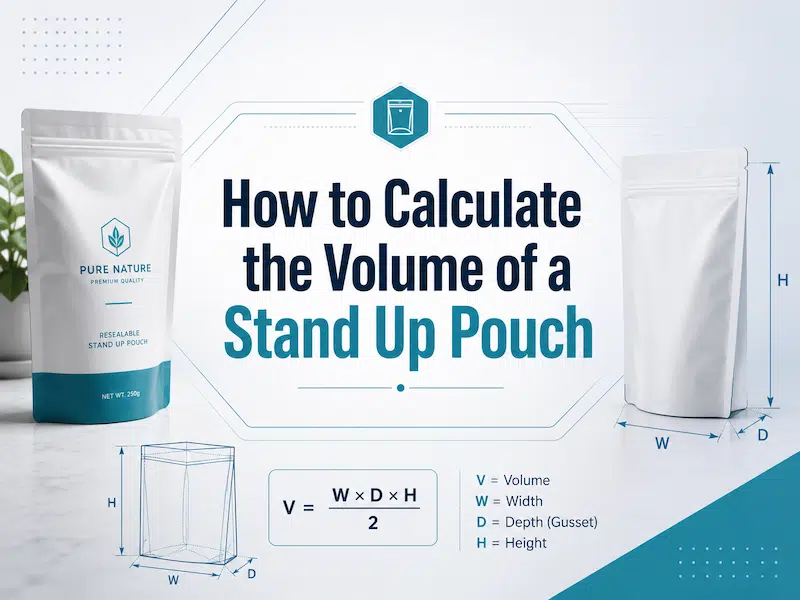
To estimate the volume of a stand up pouch, use:
Volume = Width x Height x Bottom Gusset
This gives you a rough internal volume based on the pouch dimensions. But the real fill capacity is usually lower because part of the pouch is taken up by the sealing area, zipper, rounded corners, and headspace above the product.
If you want the short version:
- Use the formula for a first estimate
- Compare that estimate with your product’s actual fill volume, not just its weight
- Leave room for sealing and product movement
- Confirm the final size with a real sample fill test
What We Look at Before Recommending a Pouch Size
As a stand up pouch manufacturer, we know that most customers do not only need a volume formula. What they really want to know is whether the pouch will work well for their actual product.
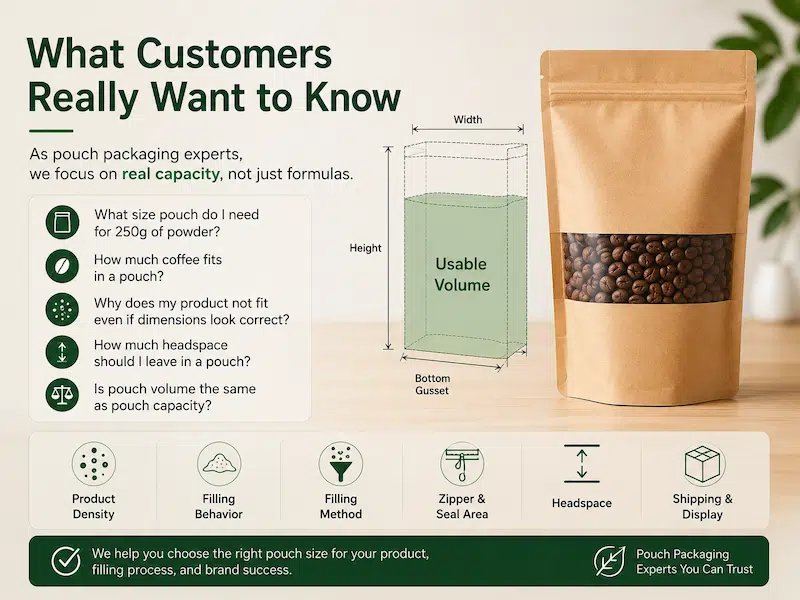
Common questions include:
- What pouch size should I use for 250g of powder?
- How much coffee can a stand up pouch hold?
- Why does my product not fit even when the pouch dimensions look correct?
- How much headspace should be left for sealing and zipper use?
- Is pouch volume the same as real filling capacity?
These questions are important because pouch capacity is affected by more than length, width, and bottom gusset. Product density, shape, settling behavior, filling method, zipper position, seal area, and required headspace can all change the usable capacity.
That is why a practical volume guide should not stop at calculation. It should help brands understand how pouch dimensions turn into real packaging performance during filling, sealing, shipping, and shelf display.
The Basic Stand Up Pouch Volume Formula
The most common way to estimate pouch volume is:
Volume = Width x Height x Bottom Gusset
Where:
- Width is the left-to-right front panel measurement
- Height is the total pouch height
- Bottom Gusset is the folded bottom depth that opens when the pouch is filled
If your dimensions are in centimeters, the result is in cubic centimeters.
If your dimensions are in inches, the result is in cubic inches.
For brands comparing standard and custom sizes, this should be treated as a planning formula, not a guaranteed fill line.
Example: How to Calculate the Volume of a Stand Up Pouch
Let us say your pouch dimensions are:
- Width: 14 cm
- Height: 22 cm
- Bottom Gusset: 8 cm
Using the formula:
14 x 22 x 8 = 2,464 cm3
That means the estimated pouch volume is 2,464 cubic centimeters, or about 2.46 liters.
This is a helpful starting point, but it does not mean you should fill the pouch all the way to that limit.
Why Calculated Pouch Volume and Real Fill Capacity Are Different
A stand up pouch is flexible packaging, not a rigid box or bottle. Once the pouch opens, fills, settles, and seals, part of the theoretical volume disappears in real use.
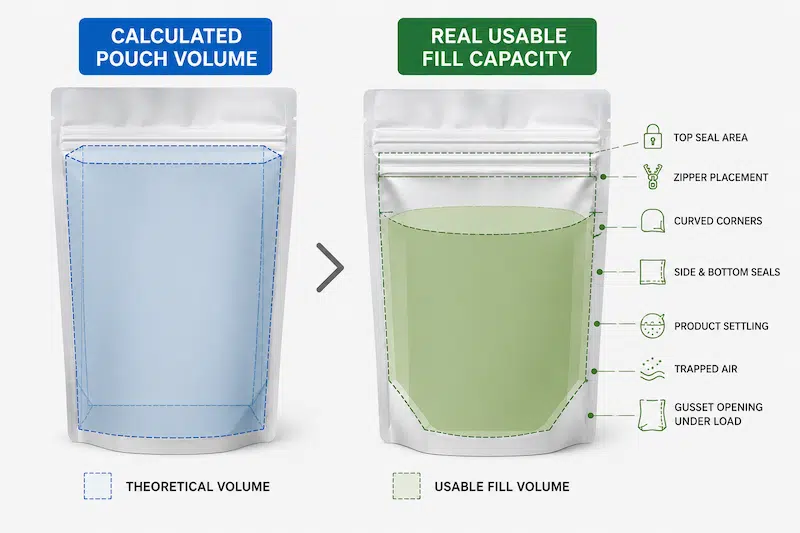
Real usable capacity is reduced by:
- the top seal area
- zipper placement
- curved pouch corners
- side and bottom seals
- product settling
- trapped air
- the way the gusset opens under load
In other words, calculated volume is a guide, while usable fill volume is the number that matters in production.
If you need a broader size reference before doing volume math, this related stand up pouch sizes guide can help you compare common dimensions by product category.
Pouch Volume Is Not the Same as Product Weight
One of the most common packaging mistakes is choosing a pouch based on weight alone.
For example, 250g of protein powder, 250g of granola, and 250g of coffee beans do not occupy the same amount of space. They weigh the same, but they behave very differently inside the pouch.
Here is the practical distinction:
- Weight tells you how heavy the product is
- Volume tells you how much physical space it needs
That is why packaging suppliers often ask what product will go into the pouch, not only how much it weighs.
How Product Type Changes the Pouch Size You Need
Your product’s density and shape have a major effect on the final pouch size.
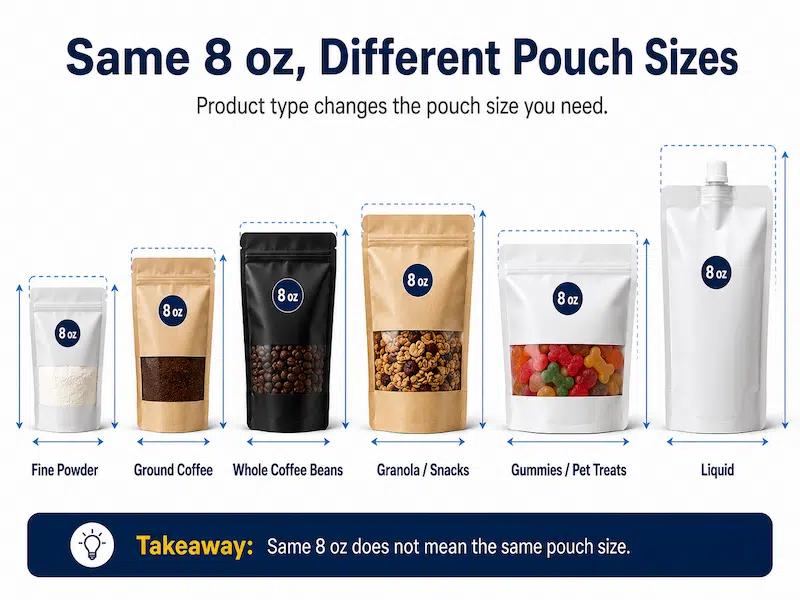
In general:
- Fine powders settle tightly and often fit into more compact pouches
- Ground coffee packs more efficiently than whole beans
- Coffee beans leave air gaps and usually need more room
- Granola and snacks are bulkier and more irregular
- Pet treats and gummies may stack unevenly
- Liquids flow more evenly but still need headspace for sealing
That is why a pouch that works for one 8 oz product may not work for another 8 oz product.
If product presentation also matters, this custom printed stand up pouches guide explains how artwork, zipper position, windows, and structure influence the final package.
A Better Way to Choose the Right Pouch Size
If you want to avoid expensive trial and error, use this practical process.
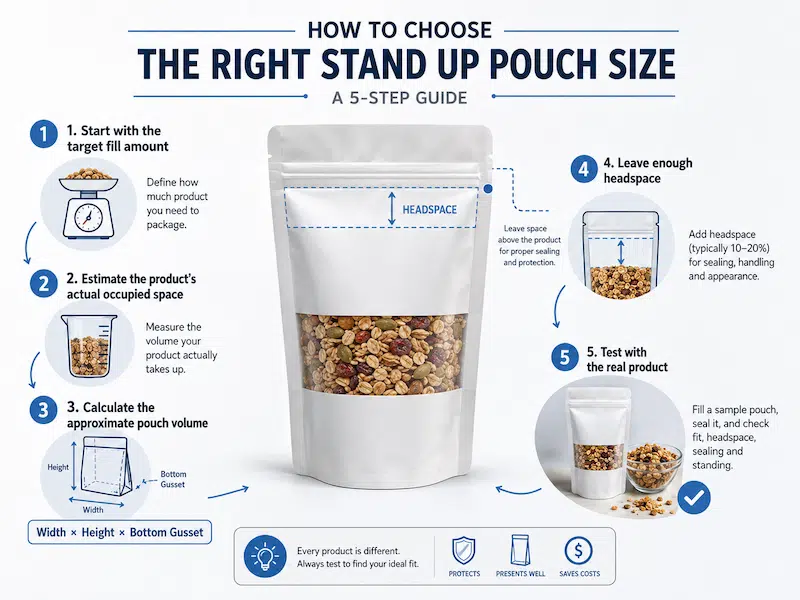
1. Start with the target fill amount
Know how much product you want in each pouch by grams, ounces, pounds, or milliliters.
2. Estimate the product’s actual occupied space
If possible, measure how much room the product takes up in a container. This is often more useful than the labeled weight by itself.
3. Calculate the approximate pouch volume
Use:
Width x Height x Bottom Gusset
This gives you a rough internal capacity.
4. Leave enough headspace
Do not size the pouch so tightly that the product sits too close to the zipper or heat seal area.
5. Test with the real product
This is still the best step. A sample fill test will tell you more than any formula can.
Approximate Stand Up Pouch Capacity Guide
The chart below is a rough starting point for dry products only. Actual results depend on density, shape, and filling method.
| Stand Up Pouch Size | Approximate Dry Fill Capacity | Typical Products |
|---|---|---|
| 3 x 5 x 2 in | about 1 oz | spices, samples, trial packs |
| 4 x 6.5 x 2.25 in | about 2 oz | candies, drink mix, small snacks |
| 5 x 8 x 3 in | about 4 oz | powder, nuts, dried fruit |
| 6 x 9.5 x 3.25 in | about 8 oz | coffee, granola, pet treats |
| 7 x 11 x 3.5 in | about 12 oz | snacks, refill pouches, beans |
| 8.5 x 11.5 x 3.5 in | about 16 oz | bulk dry goods, family packs |
If you need more exact product-by-product planning, especially for coffee, snacks, powders, or liquids, review a full stand up pouch size chart alongside your actual fill test.
How Much Headspace Should You Leave in a Stand Up Pouch?
Headspace is the empty space between the product and the zipper or top seal area. For most stand up pouches, a practical headspace range is usually 10% to 20% of the total pouch height.
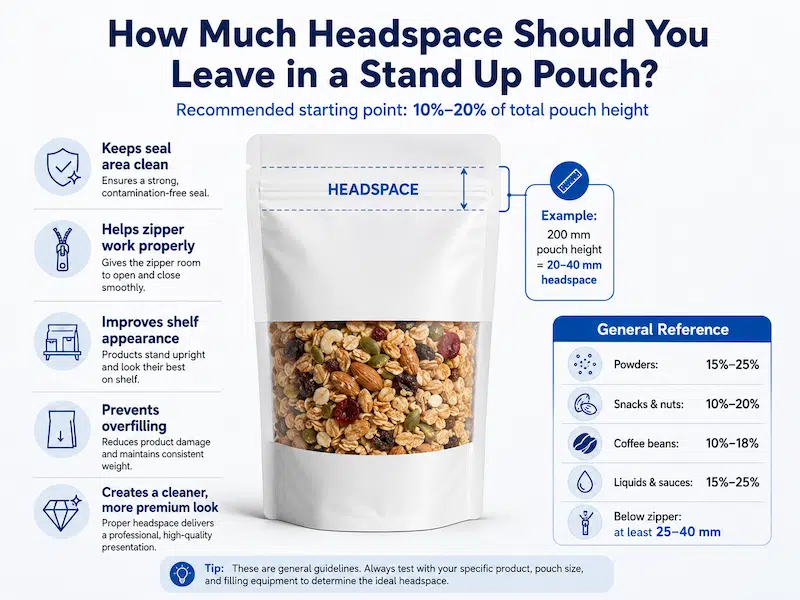
For example, if the pouch height is 200 mm, leaving around 20–40 mm of headspace is often a good starting point. This space helps keep powder, crumbs, granules, or liquid residue away from the sealing area.
As a general reference:
| Product Type | Suggested Headspace |
|---|---|
| Powder products | 15–25% |
| Granola, nuts, snacks | 10–20% |
| Coffee beans | 10–18% |
| Liquids or sauces | 15–25% |
| Products with zipper closure | At least 25–40 mm below the zipper |
Enough headspace helps the pouch seal properly, allows the zipper to work smoothly, improves shelf appearance, and reduces the risk of overfilling during production.
A pouch should look comfortably filled, not packed tightly to the top edge. If the product touches the zipper or seal area during filling, the pouch size is usually too small or the fill amount needs to be adjusted.
The best method is still a real fill test. Fill the pouch with the actual product, close or seal it, let the product settle, and check whether the pouch stands well, seals cleanly, and looks good on the shelf.
Why Sample Testing Matters More Than Any Formula
Packaging math can help you narrow down the right pouch size, but sample testing confirms what will actually work in production.
A real fill test helps you check how the pouch performs after the product is added, settled, closed, and sealed. It can show if the pouch fills smoothly, if the product drops into the bottom gusset properly, and if there is enough space around the zipper and heat seal area.
It also helps confirm shelf performance. After filling, the pouch should stand well, keep a clean shape, and look balanced instead of overfilled, soft, or unstable.
Sample testing is especially important for products with unusual shapes, oil, dust, sharp edges, or low density. These products often behave differently from what a simple volume formula suggests.
In short, the formula gives you a starting point. The sample test gives you the real answer.
If you are developing a custom stand up pouch and want to check the size before mass production, GCLPacking can help you create sample pouches for real product fill testing.
Final Thoughts
If you want a fast answer, the formula is simple:
Width x Height x Bottom Gusset
If you want the right answer for your product, you need one more step: compare that estimate with the real way your product fills, settles, seals, and presents on the shelf.
That is what helps you choose a stand up pouch that works in production, looks right in the market, and avoids costly size mistakes.
For additional reference, you can also compare how other packaging suppliers explain the topic at The Packaging Lab, StandUpPouches.net, and Accuxel.