
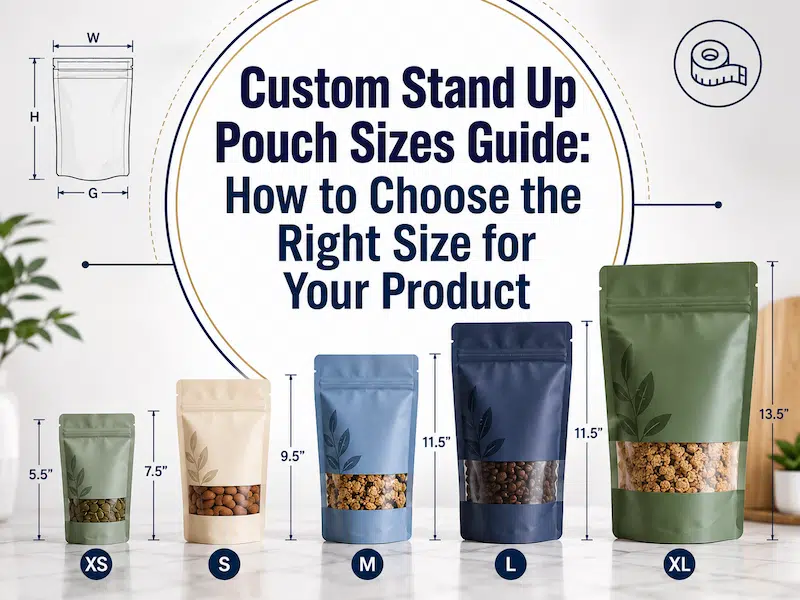
Choosing the right stand up pouch sizes sounds simple until the product goes into the pouch.
A 250g powder may fit nicely in one pouch, while 250g granola may need a much larger one. A pouch that looks good on a size chart may become hard to seal after the zipper, tear notch, valve, and bottom gusset are added. That is why a stand up pouch size chart should be used as a starting point, not the final answer.
Stand Up Pouch Size Chart: Common Dimensions and Capacity Reference
The following charts give practical size references for early planning. Actual capacity can change based on product density, material thickness, zipper position, gusset shape, and filling method.
Chart 1: Liquid Products – Estimated Volume
Liquid products need careful sealing, leak testing, and enough top space for heat sealing. If the pouch has a spout, the spout position also affects usable volume.
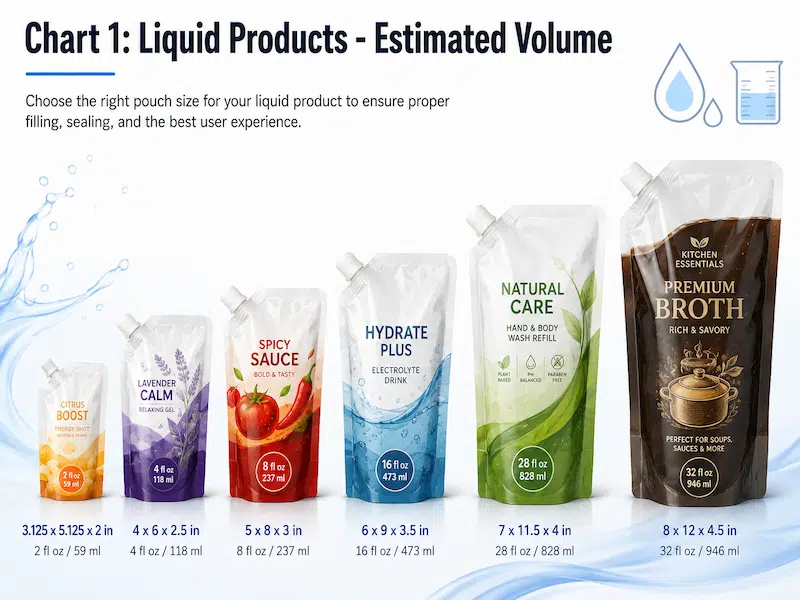
| Stand Up Pouch Dimensions | Metric Dimensions | Estimated Volume | Common Use |
|---|---|---|---|
| 3.125 x 5.125 x 2 in | 79 x 130 x 51 mm | 2 fl oz / 59 ml | Sauce samples, liquid concentrate |
| 4 x 6 x 2.5 in | 102 x 152 x 64 mm | 4 fl oz / 118 ml | Small drinks, gels, refills |
| 5 x 8 x 3 in | 127 x 203 x 76 mm | 8 fl oz / 237 ml | Sauces, liquid food packs |
| 6 x 9 x 3.5 in | 152 x 229 x 89 mm | 16 fl oz / 473 ml | Larger sauce or refill pouch |
| 7 x 11.5 x 4 in | 178 x 292 x 102 mm | 28 fl oz / 828 ml | Family-size liquids |
| 8 x 12 x 4.5 in | 203 x 305 x 114 mm | 32 fl oz / 946 ml | Large refill packaging |
For liquid products, do not choose the pouch only by volume. Test whether the seal area stays clean during filling, and confirm the pouch can stand safely after filling.
Chart 2: Powdered Products – Estimated Weight
Powders settle tightly, so they often need less space than chunky products. But they still need headspace above the fill line, especially when the pouch has a zipper.
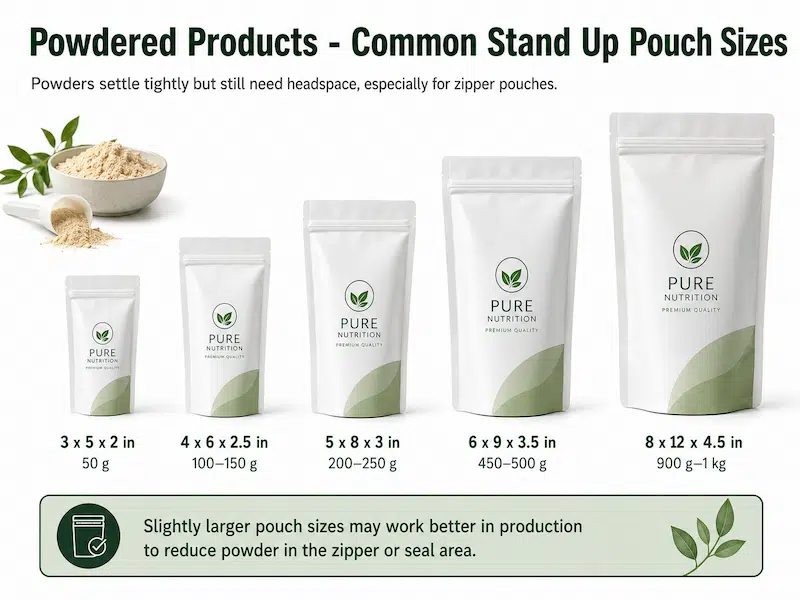
| Standard Size Stand Up Pouch Dimensions | Metric Dimensions | Estimated Powder Weight | Suitable Products |
|---|---|---|---|
| 3 x 5 x 2 in | 76 x 127 x 51 mm | 50 g | Spice powder, sample powder |
| 4 x 6 x 2.5 in | 102 x 152 x 64 mm | 100-150 g | Drink mix, small supplement pack |
| 5 x 8 x 3 in | 127 x 203 x 76 mm | 200-250 g | Protein powder, seasoning, powder refill |
| 6 x 9 x 3.5 in | 152 x 229 x 89 mm | 450-500 g | Coffee powder, supplement powder |
| 8 x 12 x 4.5 in | 203 x 305 x 114 mm | 900 g-1 kg | Bulk powder, family-size dry goods |
Powder can get trapped in the zipper or seal area. For this reason, a pouch that looks slightly large during testing may actually work better in daily production.
Chart 3: Granular or Whole Products – Estimated Weight
Granular and whole products contain more air gaps. Coffee beans, nuts, granola, dried fruit, candy, and pet treats often need larger pouch dimensions than powder at the same weight.
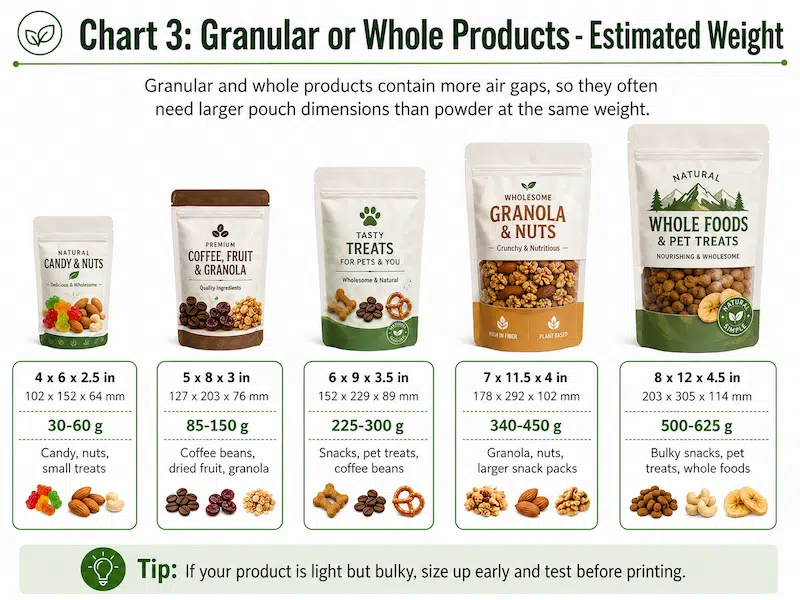
| Stand Up Pouch Dimensions | Metric Dimensions | Estimated Weight | Suitable Products |
|---|---|---|---|
| 4 x 6 x 2.5 in | 102 x 152 x 64 mm | 30-60 g | Candy, nuts, small treats |
| 5 x 8 x 3 in | 127 x 203 x 76 mm | 85-150 g | Coffee beans, dried fruit, granola |
| 6 x 9 x 3.5 in | 152 x 229 x 89 mm | 225-300 g | Snacks, pet treats, coffee beans |
| 7 x 11.5 x 4 in | 178 x 292 x 102 mm | 340-450 g | Granola, nuts, larger snack packs |
| 8 x 12 x 4.5 in | 203 x 305 x 114 mm | 500-625 g | Bulky snacks, pet treats, whole foods |
A common mistake is choosing pouch size by weight only. If your product is light but bulky, size up early and test before printing.
How to Correctly Measure a Stand Up Pouch
Stand up pouch dimensions are usually shown as:
Width x Height x Bottom Gusset
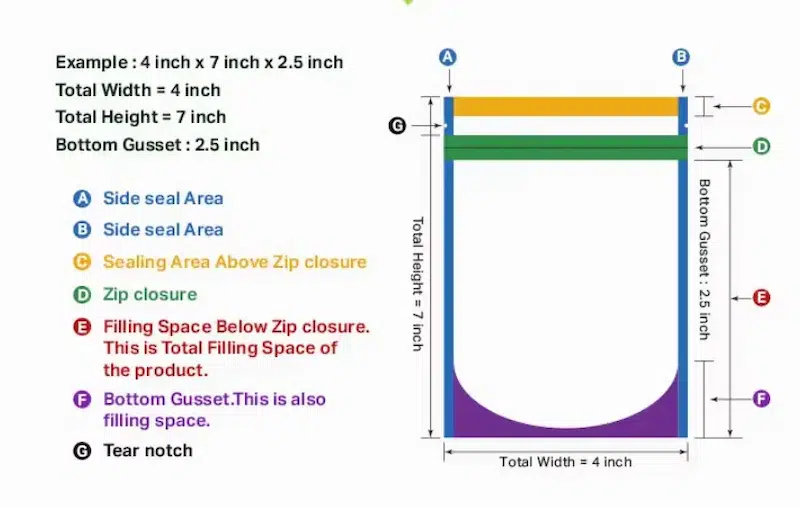
Width is the left-to-right measurement across the pouch. Height is measured from the bottom edge to the top edge. Bottom gusset is the folded bottom area that lets the pouch stand upright.
Most pouch sizes are outside measurements. This matters because the inside fillable space is smaller.
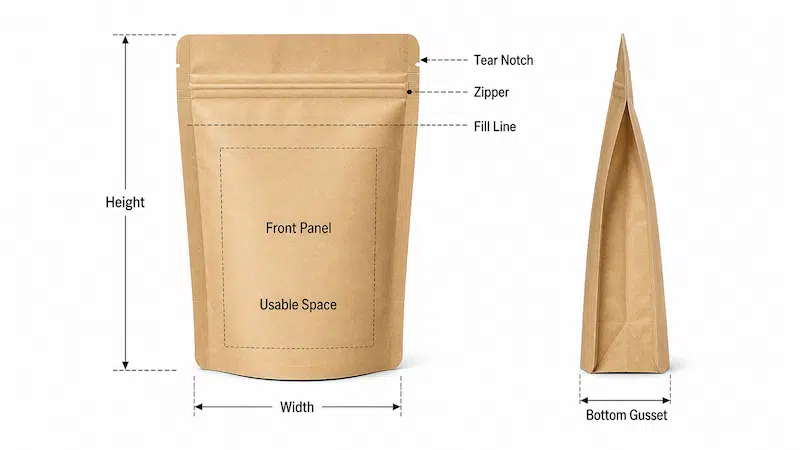
The usable space is reduced by:
- Side seals
- Bottom seal
- Zipper
- Tear notch
- Hang hole
- Degassing valve
- Heat seal area
- Bottom gusset shape
So, a 6 x 9 x 3.5 inch pouch does not give you the full 6 x 9 inch space for product. The product must sit below the zipper and away from the final seal area.
Why Product Density Decides the Final Size
Product density is the biggest reason two products with the same weight need different pouch sizes.
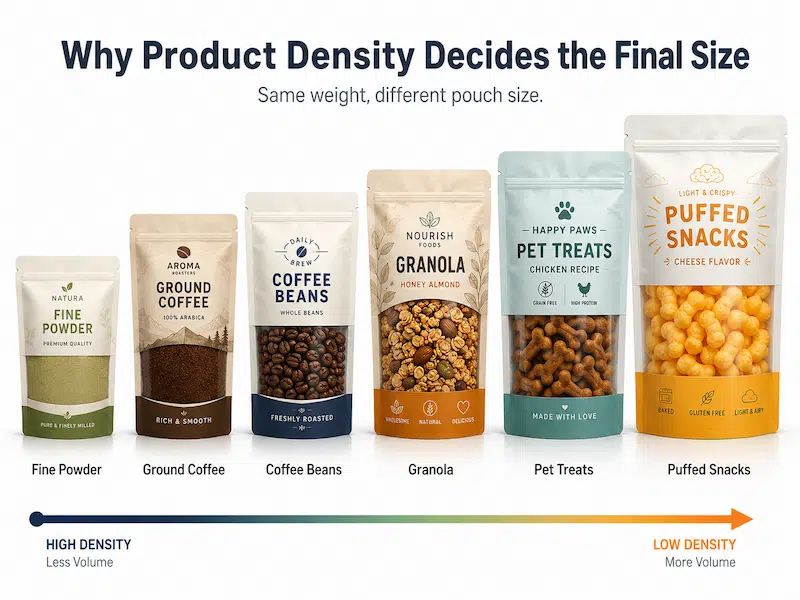
Think of it this way: 250g of fine powder packs down tightly. 250g of granola has flakes, nuts, air gaps, and uneven shapes. The label weight may be the same, but the space needed is not.
| Product Type | Density Level | Size Impact |
|---|---|---|
| Fine powder | High | Can use a more compact pouch |
| Ground coffee | Medium-high | Needs headspace for settling and sealing |
| Coffee beans | Medium | Usually needs more volume than ground coffee |
| Granola | Low-medium | Often needs a wider or taller pouch |
| Pet treats | Low-medium | Shape and air gaps affect final size |
| Puffed snacks | Low | Usually needs a larger pouch |
This is why there is no universal pouch size calculator that works for every product. A calculator can give a rough estimate. A real fill test gives the answer.
How Filling Method Affects Pouch Size
Manual filling and automated filling do not always need the same pouch size.
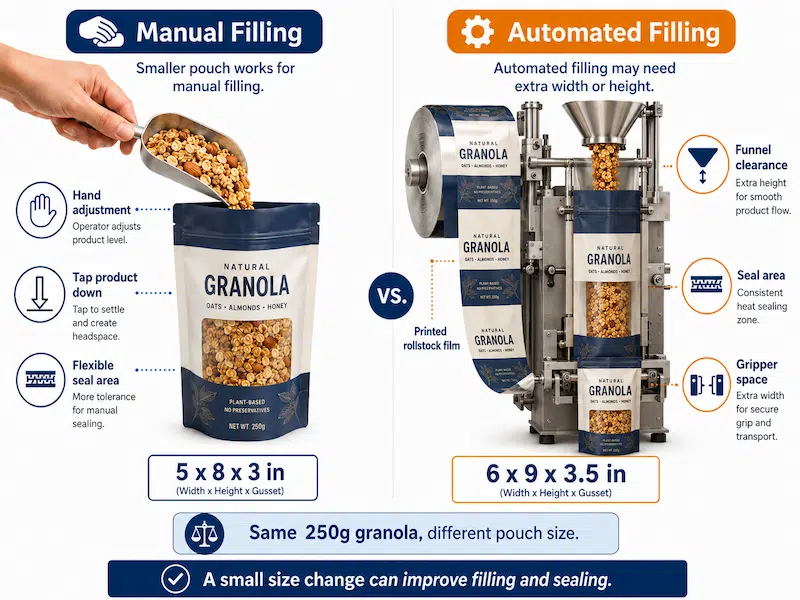
With manual filling, the operator can adjust the pouch by hand, tap the product down, and control the seal area. This gives more flexibility.
With automated filling, the pouch must work with the machine. The opening needs enough width for the filling funnel. The top area needs space for sealing bars. The machine grippers also need enough pouch material to hold the pouch correctly.
A pouch that works for hand filling may need extra width or height when moved to automated production. Summit Packaging notes that automated systems may require adjustments for funnel clearance, seal area, and gripper compatibility.
A simple example: a 250g granola product may seem to fit in a 5 x 8 x 3 inch pouch during hand filling. But after testing, the brand may move to a 6 x 9 x 3.5 inch pouch because the granola needs more room to drop cleanly, settle evenly, and stay below the zipper.
That small size change can reduce sealing problems and make production smoother.
Beyond Dimensions: Shelf Appeal and User Experience
The right pouch size should look good when filled.
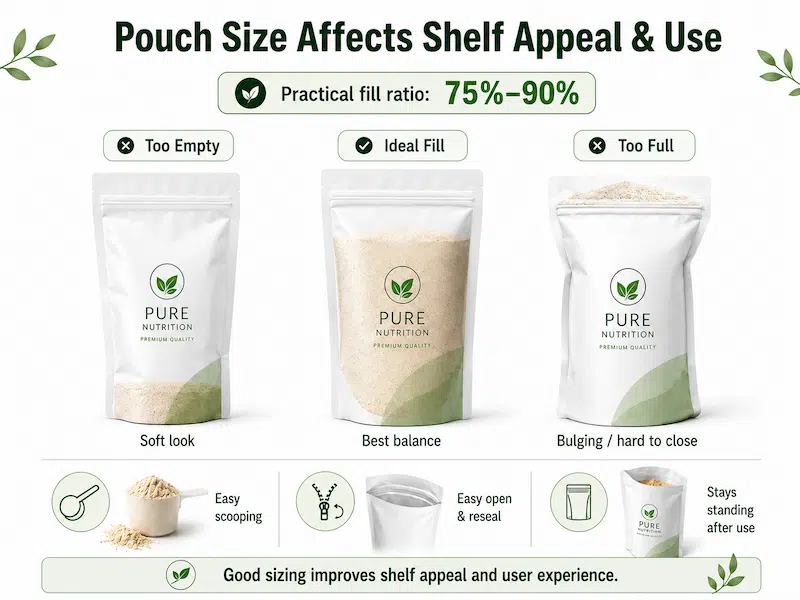
If a pouch is too empty, it may look soft, flat, or weak on the shelf. The front panel can wrinkle, and the pouch may not stand well.
If a pouch is too full, it may bulge. The zipper may be hard to close. The seal area may get dirty. The bottom gusset may round out instead of standing flat.
A practical fill ratio is often around 75% to 90%, depending on the product. This leaves room for sealing, zipper function, and product movement during shipping.
User experience also matters. For powder products, people may need room for a scoop. For snacks, the pouch should be easy to open and reseal. For coffee, the pouch should stand well after part of the product is used.
Good sizing is not just about fitting the product. It is about making the pouch easy to use.
How Material and Features Affect Size Choice
Material changes how the pouch opens, fills, and stands.
A soft plastic laminate may expand more easily. A kraft paper laminate may feel stiffer and more structured. Aluminum foil structures offer stronger barrier protection, but they can also feel less flexible than thinner films.
For kraft pouches, the same outside dimensions may feel slightly tighter because the material is usually stiffer. For aluminum foil bags, the barrier is stronger, but folding behavior and seal design must be checked carefully. For custom printed stand up pouches, the size also needs to support the front artwork, nutrition panel, barcode, window, and other layout needs.
Common features that affect pouch size include:
- Zipper
- One-way valve
- Clear window
- Hang hole
- Tear notch
- Round corner
- Spout
- Bottom gusset style
A coffee pouch with a valve needs enough space above the fill line and enough front panel area for both branding and function. A snack pouch with a window needs the window placed where the product looks full and attractive.
Stock Stand Up Pouches vs. Custom Stand Up Pouches
Stock stand up pouches are useful for early testing, small product launches, and common dry products. They are faster to source and can help you compare several sizes before deciding.
Custom stand up pouches are better when the product has special requirements.
Choose custom sizing when:
- The product is bulky or irregular
- The pouch must fit a specific carton
- The filling machine needs certain dimensions
- The brand needs a stronger shelf shape
- The pouch needs a window, valve, zipper, or special finish
- Standard size stand up pouch dimensions create too much empty space
Stock sizes are a good starting point. Custom sizes are better when packaging performance and shelf presentation need tighter control.
The Golden Rule: Always Test With Samples First
A stand up pouch size chart can guide the first decision. Samples confirm the real decision.
Before mass production, test:
- Target fill weight
- Fill ratio
- Zipper function
- Heat seal quality
- Pouch stability
- Carton packing
- Shelf appearance
- Machine compatibility
- Product settling after shaking
- Moisture or oil exposure when relevant
Test with the real product, not a similar product. If the product has oil, dust, sharp edges, or irregular shapes, the pouch may behave differently than expected.
Sample testing is the safest way to confirm final stand up pouch dimensions before printing plates, digital artwork, or large production plans are approved.
Frequently Asked Questions About Stand Up Pouch Sizing
What is the most common stand up pouch size?
Common sizes include 4 x 6 x 2.5 inches, 5 x 8 x 3 inches, 6 x 9 x 3.5 inches, and 8 x 12 x 4.5 inches. The best size depends on product density, fill weight, zipper position, and shelf goals.
How are stand up pouch dimensions measured?
They are usually measured as Width x Height x Bottom Gusset. Most dimensions are outside measurements, so the inside fillable space is smaller than the listed size.
What size stand up pouch do I need for 250g?
For 250g powder, a 5 x 8 x 3 inch pouch is often a useful starting point. For 250g granola, coffee beans, or pet treats, you may need a larger pouch because the product takes up more space.
What size pouch is best for 12 oz coffee?
For 12 oz coffee, many brands start testing around 6 x 9 x 3.5 inches or nearby dimensions. Whole beans usually need more room than ground coffee. A valve and zipper also reduce usable space.
Do kraft stand up pouches use different dimensions?
Kraft stand up pouch dimensions may look the same on paper, but kraft material can feel stiffer than soft film. This can slightly affect filling, gusset expansion, and shelf shape. Always test using the final kraft material structure.
Should I choose stock size or custom size?
Choose stock size for faster sampling and common dry products. Choose custom size when the product is bulky, the pouch needs special features, the carton fit is important, or the packaging must work with automated filling equipment.
Final Thoughts
A stand up pouch size chart is helpful for early planning, but it cannot replace real product testing. The final pouch size should be based on product weight, volume, density, filling method, material, pouch features, and shelf presentation.
The best pouch is not simply the smallest pouch that can hold the product. It should fill well, seal cleanly, stand firmly, look balanced, and work smoothly during packing.
GCLPacking helps brands confirm pouch size through dimension planning, dieline review, material selection, sample testing, and mass production control. With the right process, a stand up pouch can protect the product, look good on the shelf, and make daily use easier for the final customer.
Sources referenced: BS Flex Pack size chart, Accuxel common standard sizes, Summit Packaging sizing guide.