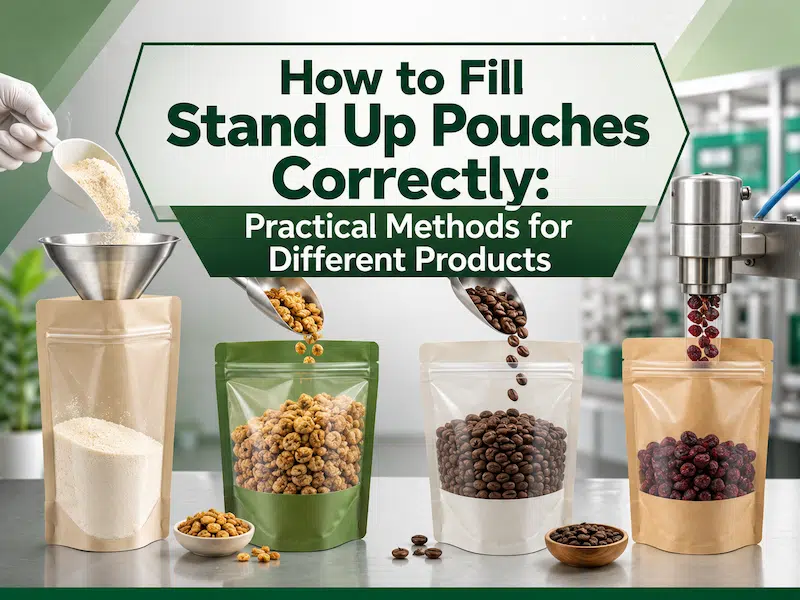
How to Fill Stand Up Pouches Correctly: Practical Methods for Different Products

Table of Contents

how to fill stand up pouches

If you want to know how to fill stand up pouches correctly, you need more than a simple “open, fill, and seal” answer. Each product behaves differently. Powder creates dust. Sauce can leak. Coffee releases gas. Snacks can break. Liquids need the right pouch structure and filling control.

This guide helps you choose a filling method that matches your product, pouch type, and production volume.

By reading this article, you will learn:

  • How to prepare stand up pouches before filling
  • Which filling method works best for powders, snacks, liquids, sauces, coffee, pet food, and supplements
  • How manual filling, funnel filling, semi-automatic filling, premade pouch machines, form-fill-seal systems, and spouted pouch filling work
  • Which pouch types suit different filling methods
  • What problems can happen during filling and sealing
  • How to avoid leaks, messy zippers, weak seals, poor shelf appearance, and product waste
  • When you should upgrade from hand filling to machine filling

A good filling process protects your product. It also improves shelf appearance, customer experience, and packaging reliability.

If you have any questions about choosing custom flexible pouches or selecting the right filling method, you can contact GCLPacking. Our team will give you a professional packaging solution based on your product, filling process, shelf-life needs, and brand requirements.

Start With the Product, Not the Machine

Before you choose a filling method, look closely at the product.

How Product Characteristics Affect Stand-Up Pouch Filling

Ask these questions:

  • Does the product flow freely?
  • Does it create dust?
  • Does it drip, foam, clump, or stick?
  • Does it contain oil, moisture, or acid?
  • Does it release gas after packaging?
  • Does it need a zipper, spout, valve, or high-barrier film?
  • Can it damage or puncture the pouch?
  • Does it need food-grade, retort, hot-fill, or cold-fill packaging?

The top seal area also matters. A clean seal area gives you a stronger seal. Powder, oil, sauce, crumbs, salt, sugar, and moisture can all weaken sealing performance.

For food products, packaging materials should meet food-contact requirements. The FDA food contact substances resource explains the role of safe packaging materials.

Manual Filling: Best for Small Batches and Dry Products

Manual filling is the simplest way to fill stand up pouches. It works when you use a scoop, spoon, measuring cup, or small container to add product by hand.

This method is a good fit for small brands, sample runs, farmers’ market products, handmade goods, and early-stage retail testing.

It works especially well for coffee beans, loose tea, nuts, candy, dried fruit, gummies, pet treats, bath salts, capsules, tablets, and coarse granules.

Manual filling usually works with zipper stand up pouches, kraft laminated pouches, clear-front pouches, foil pouches, sample pouches, and flat-bottom pouches for dry goods.
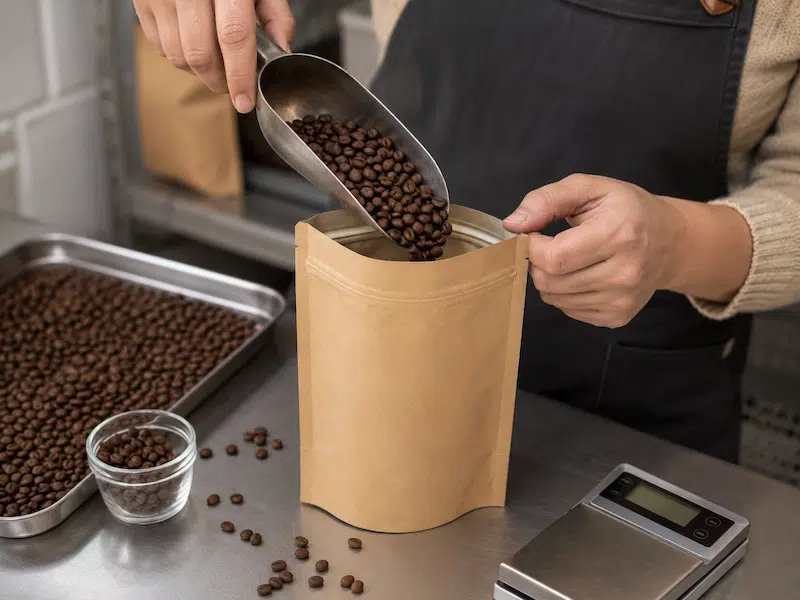
Small-Batch Coffee Bean Filling for Stand Up Pouch Packaging

How to fill by hand

  • Open the zipper completely.
  • Push out the bottom gusset so the pouch can stand upright.
  • Place the pouch on a flat table or in a pouch holder.
  • Add the product slowly into the center of the pouch.
  • Tap the pouch gently so the product settles into the bottom.
  • Weigh the filled pouch on a digital scale.
  • Add or remove product until the net weight is correct.
  • Clean the zipper and seal area.
  • Close the zipper.
  • Heat seal the top edge above the zipper.
  • Press the pouch gently and check whether air escapes.

Tips:

  • Manual filling gives you control, but it needs discipline. The bottom gusset must open before filling. The product should not reach the top seal area. Every pouch should be weighed if you sell by net weight.
  • For bulky products, do not fill everything at once. Add part of the product, settle it, then add the rest. This helps the pouch stand better.
  • For fragile snacks, avoid hard tapping. A clean-looking pouch is not useful if the product inside is broken.

Funnel Filling: Better Control for Powders and Small Granules

Funnel filling is still simple, but it gives you more control than direct scooping.

It is useful when the product is small, dusty, or easy to spill into the zipper. The funnel guides product below the zipper line and keeps the top of the pouch cleaner.
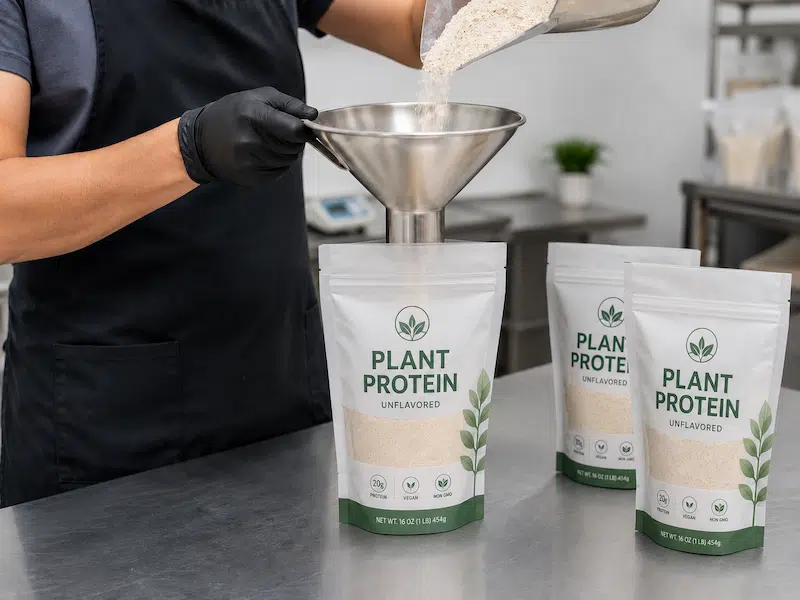
Powder Stand Up Pouch Filling With a Funnel

This method suits protein powder, spices, flour, baking mix, collagen powder, powdered drinks, salt, sugar, seeds, rice, loose tea, and small granules.

It works well with powder pouches, supplement pouches, spice pouches, zipper stand up pouches, foil pouches, kraft laminated pouches, and clear-front pouches.

A practical filling flow

  • Use a wide-mouth funnel.
  • Open the pouch and expand the bottom gusset.
  • Place the pouch in a holder if it cannot stand firmly.
  • Insert the funnel so the outlet sits below the zipper line.
  • Pour slowly.
  • Fill fine powder in several small portions.
  • Pause between pours so powder can settle.
  • Tap the pouch lightly to level the product.
  • Lift the funnel straight up.
  • Brush powder away from the zipper and seal area.
  • Close and heat seal the pouch.

Tips:

  • The funnel should not be too narrow, as fine powder can clog or stay inside the neck. Powder control is important. If powder reaches the zipper or seal area, sealing may be affected.
  • For better filling and sealing, keep the pouch filling capacity around 75%–85%. If the powder is very fine, sticky, or expensive, an auger filler is usually a better choice than a basic funnel.

Semi-Automatic Filling: When You Need More Accuracy

Semi-automatic filling is the natural next step when manual filling becomes too slow.
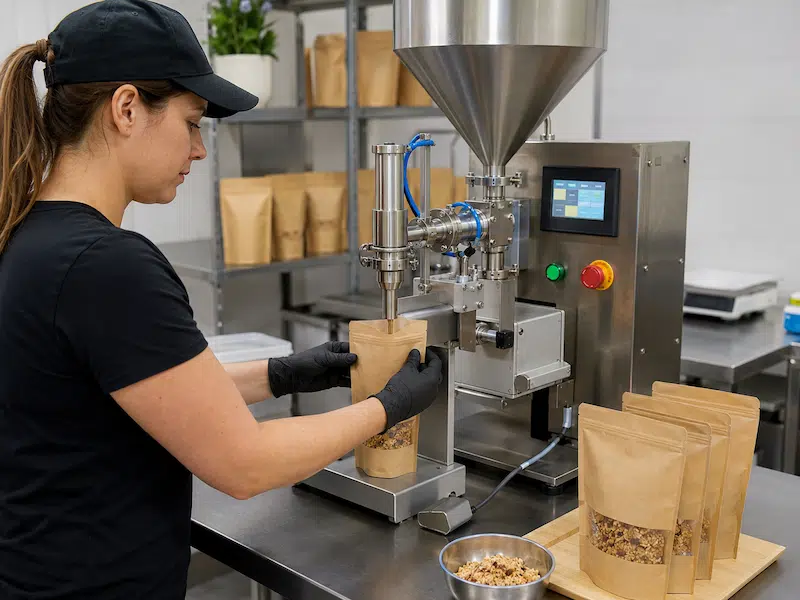
Semi-Automatic Filling for Stand Up Pouch Packaging

The operator still places or holds the pouch. The machine controls the dose. This improves speed, weight accuracy, and batch consistency.

This method is useful for growing brands that fill powders, granules, coffee, nuts, snacks, candy, pet treats, sauces, oils, lotions, gels, detergents, and similar products.

It can work with zipper stand up pouches, foil pouches, kraft laminated pouches, flat-bottom pouches, liquid pouches, sauce pouches, cosmetic refill pouches, and household product pouches.

The key is to match the filler to the product:
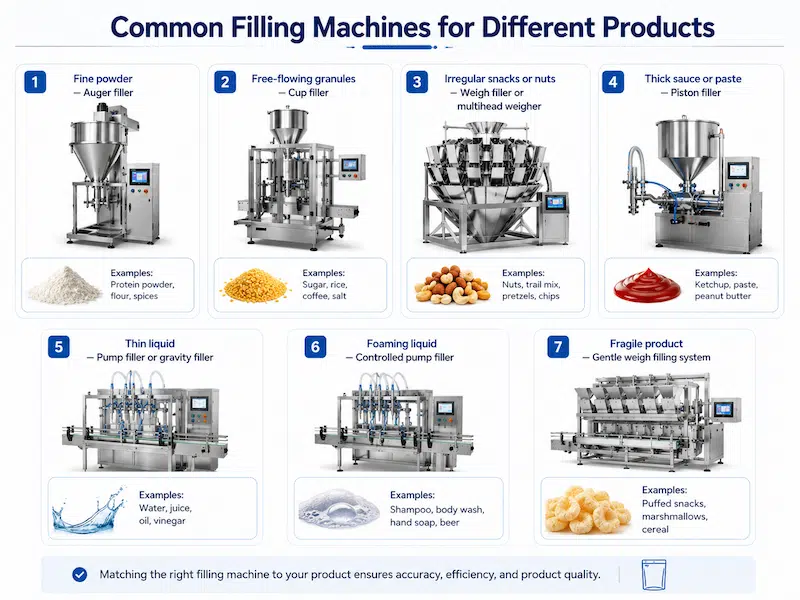
Common Filling Machines for Different Products

Product BehaviorBetter Filler Choice
Fine powderAuger filler
Free-flowing granulesCup filler
Irregular snacks or nutsWeigh filler or multihead weigher
Thick sauce or pastePiston filler
Thin liquidPump filler or gravity filler
Foaming liquidControlled pump filler
Fragile productGentle weigh filling system

How the process usually works

  • Set the target weight or volume.
  • Run a small test batch.
  • Weigh several filled pouches.
  • Adjust speed, dose, hopper level, or nozzle height.
  • Open the pouch and expand the bottom gusset.
  • Hold the pouch under the nozzle or use a pouch holder.
  • Start the fill cycle.
  • Let the machine finish the full dose.
  • Allow the product to settle.
  • Clean the seal area.
  • Heat seal the pouch.
  • Check weight, seal quality, residue, and leaks during the run.

Tips:

  • Nozzle position matters more than many people expect.
  • For powders, a lower nozzle can reduce dust. For liquids, a controlled nozzle helps prevent splashing. For sauces and gels, an anti-drip nozzle can prevent product from landing on the seal area.
  • Semi-automatic filling does not remove the need for inspection. You still need to check weights, seals, pouch shape, and product residue throughout production.

Premade Pouch Filling Machine: For Retail-Scale Production

A premade pouch filling machine uses pouches that are already made and printed. The machine picks up each pouch, opens it, fills it, seals it, and releases it.
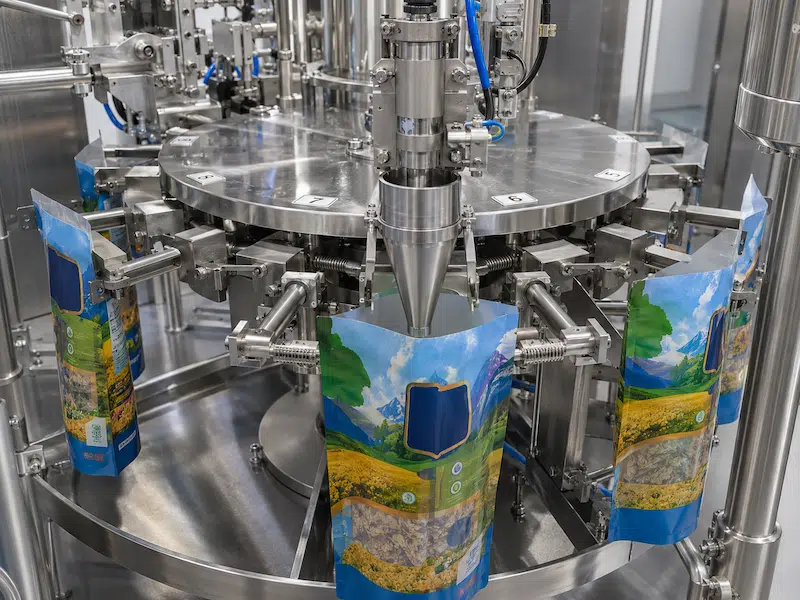
Rotary Premade Pouch Filling for Retail-Scale Production

This method is suitable for medium and high-volume brands that need consistent retail packaging.

It works with printed stand up pouches, zipper pouches, foil pouches, kraft laminated pouches, flat-bottom pouches, high-barrier pouches, and shaped pouches.

It can pack coffee, snacks, nuts, candy, pet treats, supplements, powders, frozen food, sauces, detergents, cosmetics, and household products.

What happens inside the machine

  • Empty pouches are loaded into the pouch magazine.
  • The machine picks one pouch at a time.
  • Grippers hold the pouch.
  • The pouch mouth opens by suction or mechanical opening.
  • A sensor checks whether the pouch is open.
  • The date code or batch code is printed if needed.
  • The dosing system fills the pouch.
  • The pouch may be vibrated, flushed with nitrogen, or dust-cleaned.
  • Heat sealing bars seal the top.
  • Cooling bars flatten and strengthen the seal.
  • The finished pouch is discharged for inspection.

Tips:

  • This method depends heavily on pouch consistency. If the pouch size, zipper position, film stiffness, or opening quality varies too much, the machine may misfeed or skip pouches.

Different products also need different machine settings.

Powders may need dust extraction. Liquids may need anti-drip nozzles. Snacks may need gentle handling. Coffee may need a degassing valve. Supplements may need moisture protection. Oxygen-sensitive products may need nitrogen flushing.

For more technical background, this premade pouch filling machine overview explains how automatic pouch filling equipment works.

Form-Fill-Seal: Best for High-Volume Production

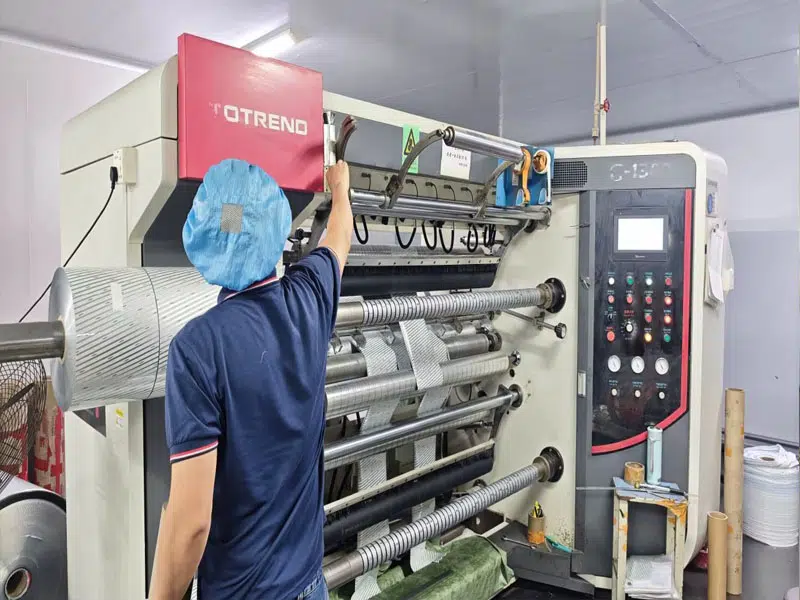
Form-fill-seal machines do not use premade pouches. They use rollstock film and create the pouch during production.
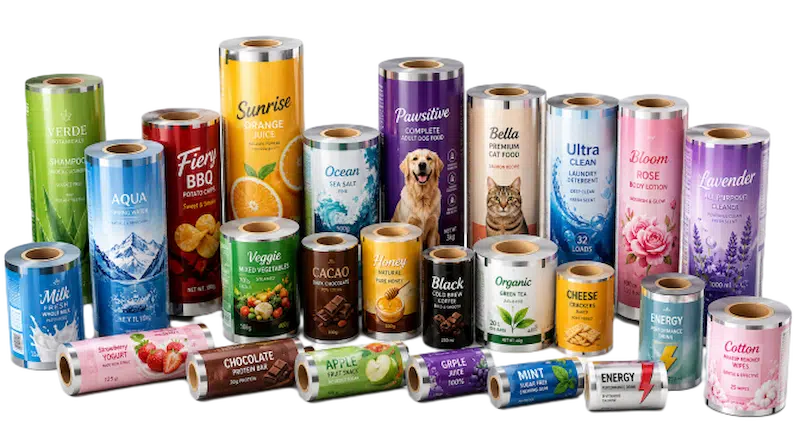
custom roll stock lamination film manufacturer

The machine forms the pouch, fills it, seals it, cuts it, and discharges the finished pack.

This method is usually used for large production runs, stable SKUs, and high-speed packaging lines.

It can pack snacks, grains, rice, coffee, sugar, candy, frozen food, powder, pet food, wipes, liquids, medical products, and specialty products.

It works with rollstock film formats such as VFFS pouches, HFFS pouches, shaped pouches, spouted formats, sachets, and other high-volume flexible packaging formats.

VFFS and HFFS are not the same
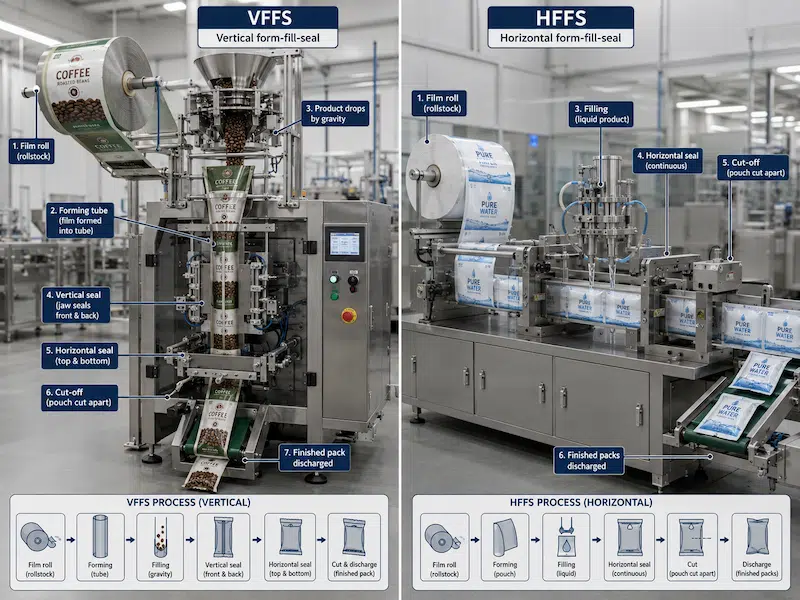
VFFS vs HFFS Rollstock Film Packaging Machines

VFFS means vertical form-fill-seal. The product usually drops into the pouch from above. This works well for products that flow by gravity, such as snacks, grains, coffee, sugar, powder, frozen food, and pet food.

HFFS means horizontal form-fill-seal. The film moves horizontally through the machine. This works better for shaped pouches, spouted pouches, wipes, liquids, medical packs, and specialty packaging.

The process in simple terms

  • Rollstock film is loaded into the machine.
  • Film direction, print repeat, and tension are adjusted.
  • The machine forms the pouch shape.
  • The bottom or side seals are created.
  • Product enters the pouch.
  • The remaining opening is sealed.
  • The pouch is cut from the film.
  • The finished pack is discharged.
  • Seal strength, print position, fill amount, and cutting accuracy are checked.

Tips:

  • This method can lower unit cost at scale. But it also needs more technical setup. Film tension, sealing temperature, product drop timing, cutting position, and print registration must all be controlled.
  • For many startups, premade pouches are easier and more flexible. Form-fill-seal becomes more attractive when volume is stable and large.

Spouted Pouch Filling: For Liquids, Sauces, Gels, and Squeezable Products

Spouted pouch filling is different from filling a standard zipper pouch.
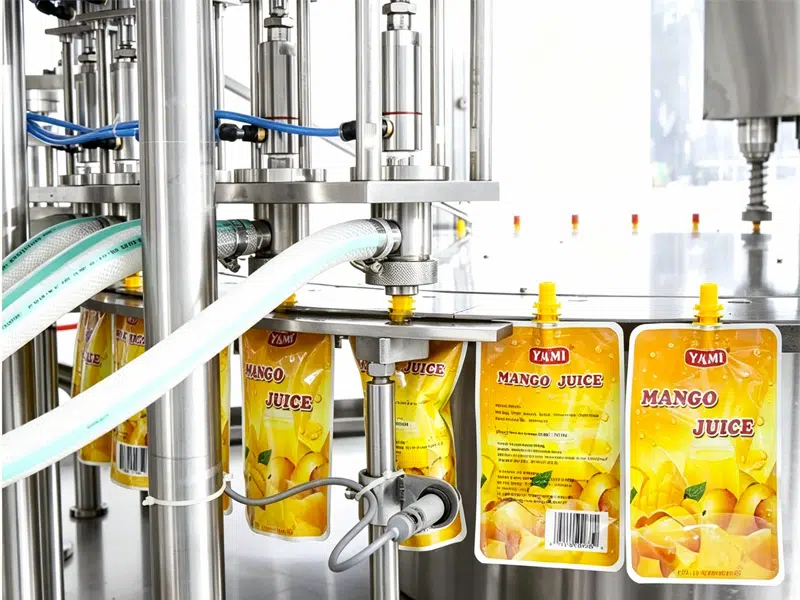
Automatic_Spouted_Pouch_Filling_for_Juice_and_Liquid_Packaging

The pouch has a spout and cap. The product is usually poured, squeezed, or dispensed by the customer.

This method is used for baby food, smoothies, juice, sauce, ketchup, honey, syrup, soup, shampoo, conditioner, lotion, detergent, gel, and liquid supplements.

It works with spouted stand up pouches, baby food pouches, beverage pouches, sauce pouches, cosmetic refill pouches, detergent refill pouches, and fitment pouches.

Before filling, check compatibility

Liquid products can be difficult. Acidic sauces, oily dressings, alcohol products, shampoos, and baby food purees may need different film structures.

Check:

  • Laminate structure
  • Sealant layer
  • Spout material
  • Cap type
  • Filling temperature
  • Product acidity
  • Oil or alcohol content
  • Shelf-life requirement

How spouted pouch filling works

  • Confirm whether the pouch is filled through the spout or through the top opening.
  • Choose the filler based on viscosity.
  • Use gravity filling for thin liquids.
  • Use pump filling for controlled liquid filling.
  • Use piston filling for sauces, purees, honey, gels, and creams.
  • Use sanitary filling for food, beverage, or baby food.
  • Set filling speed based on splash, foam, and product thickness.
  • Leave enough headspace.
  • Clean the spout and cap thread.
  • Apply the cap with correct torque.
  • Turn the pouch upside down.
  • Press gently and check for leakage.

Tips:

  • Headspace is especially important. Too little headspace can cause swelling, leaking, or cap pressure. Too much headspace can make the pouch look underfilled.
  • Cap torque also matters. A loose cap leaks. An over-tight cap can damage the spout or make the product hard to open.
  • For hot-fill, retort, or baby food products, use validated processing requirements. This spouted pouch filling guide gives more background on spouted pouch filling.

Which Filling Method Fits Your Product?

Different products need different filling methods. The table below gives a practical reference based on product flow, dust, moisture, sealing risk, and pouch performance.

Product TypeRecommended Filling MethodMain Risk
Coffee beansManual filling, weigh filler, premade pouch machineGas release and pouch swelling
Protein powderFunnel filling, auger fillerPowder in zipper or seal area
SpicesFunnel filling, auger fillerDust and static
NutsManual filling, cup filler, weigh fillerUneven weight
CandyManual filling, weigh filler, premade pouch machineProduct damage or uneven fill
Pet treatsManual filling, weigh filler, premade pouch machineBulky product and unstable pouch
SaucePiston filler, pump filler, spouted pouch fillerDripping and weak seals
OilLiquid filler, spouted pouch fillerLeakage and material compatibility
Baby foodSpouted pouch filling with validated processFood safety and shelf life
Bath saltsManual filling, funnel fillingMoisture and zipper contamination
DetergentPump filler, spouted pouch fillingChemical compatibility

Common Filling Problems and Simple Fixes

ProblemLikely CauseSimple Fix
Powder enters the zipperFunnel is too high or product flow is uncontrolledUse a funnel, chute, or auger filler and fill below the zipper line
Pouch leaks after sealingSeal area has powder, oil, sauce, crumbs, or moistureClean the seal area before heat sealing
Pouch does not stand uprightBottom gusset is not fully opened or pouch is too narrowOpen the gusset fully or choose a wider pouch
Pouch looks underfilledProduct density is lowChoose a larger pouch or adjust fill volume
Heat seal wrinklesWrong temperature, pressure, or dwell timeAdjust sealer settings and test again
Pouch swells after sealingGas release, poor headspace, or wrong barrier materialUse a degassing valve, adjust headspace, or improve barrier structure
Product punctures pouchFilm structure is too weakUse a stronger laminate

Final Filling Checklist

Before production, check the pouch size against the real product volume.

Make sure the pouch material matches the product. Open the bottom gusset fully. Keep the product below the zipper and seal area.

Check the fill weight. Clean the zipper. Heat seal with the correct settings.

After sealing, inspect the finished pouch. The seal should be flat and complete. The pouch should stand upright. It should also pass a squeeze or leak test.

Conclusion

Filling stand up pouches is much easier when the pouch and filling method match the product.

Manual filling is useful for small dry batches. Funnel filling helps with powders and small granules. Semi-automatic filling improves speed and accuracy. Premade pouch machines support retail-scale production. Form-fill-seal systems fit high-volume lines. Spouted pouch filling is best for liquids, sauces, gels, and squeezable products.

The pouch itself also affects filling. Size, bottom gusset, zipper type, film structure, barrier level, valve, and spout all matter.

If you want to avoid leaks, messy seals, poor shelf appearance, or the wrong pouch structure, GCLPacking can help you design stand up pouches around your product and filling process.

You can start with GCLPacking’s custom stand up pouches or contact the GCLPacking team for advice on pouch size, material, zipper, spout, valve, barrier layer, and custom printing.

FAQs

Can I fill stand up pouches by hand?

Yes. You can fill stand up pouches by hand for small batches, samples, handmade products, and startup production. Use a clean scoop, digital scale, pouch holder, and heat sealer.

Do not fill the pouch to the very top. Many products work best when the pouch is filled to around 70% to 80% of its usable volume. The exact level depends on product type, pouch size, and sealing method.

Yes, if you sell the product commercially. The zipper helps the customer reclose the pouch. The heat seal protects freshness and shows that the pouch has not been opened.

The seal area may be dirty. Powder, oil, sauce, crumbs, or moisture can weaken the seal. Wrong sealing temperature, pressure, or sealing time can also cause leakage.

Yes, but only if the pouch material is designed for hot filling. The film, sealant layer, zipper, spout, and cap must all tolerate the filling temperature.

For dry products, start with manual filling or funnel filling. For powders, consider an auger filler when volume grows. For sauces and liquids, use a piston or pump filler.

gclpacking_company_logo

Factory direct | Support Design

Ready to Manufacture?

Get instant pricing & free design solution

10+

manufacturing years

1000+

 packaging designs

98%

Reliable On-time Delivery

Latest Insights From Our Experts