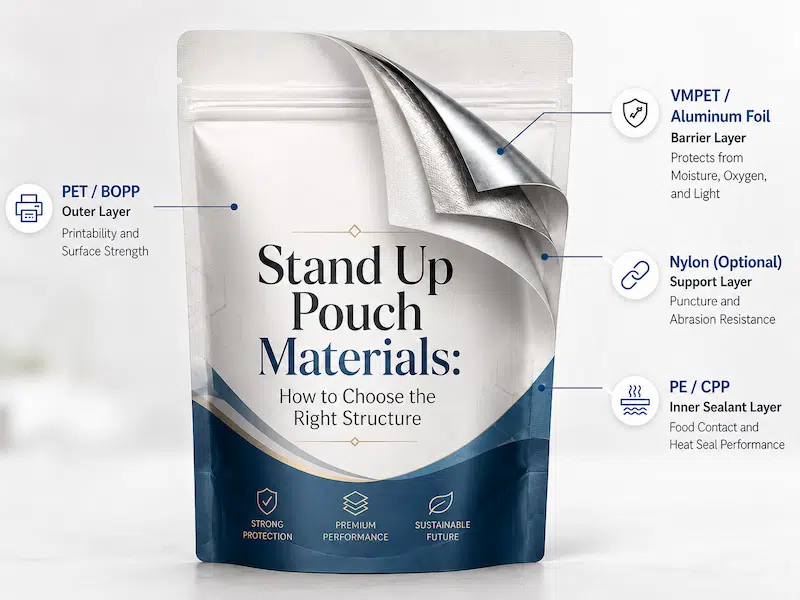

Which Flexible Packaging Material Should You Choose?
PET, PE, PA, AL and VMPET each solve a different packaging problem. The right structure is not the thickest film or the most complicated laminate. It is the structure that protects the product, seals reliably, works with the filling process and supports the required shelf life without adding unnecessary cost.
- PET is commonly used as the printable outer layer.
- PE is commonly used as the inner heat-seal and product-contact layer.
- PA, also called nylon, adds puncture resistance and toughness.
- AL means real aluminum foil and is used where demanding barrier performance is required.
- VMPET is metallized PET. It improves barrier and blocks light, but it is not the same as aluminum foil.
A relatively stable dry product may work with PET/PE. Coffee, powders and other oxygen- or moisture-sensitive products may require PET/VMPET/PE or PET/AL/PE. Heavy, sharp or frozen products may need PA/PE or PET/PA/PE.
In other words, buyers are usually not trying to learn material abbreviations for their own sake. They are trying to answer a more practical question: Which material structure fits my product, shelf-life target and filling method? The following sections are designed to answer that question clearly.
Understand the Role of Each Layer Before Comparing Structures
Before discussing laminate combinations, it helps to understand what each material usually contributes. In most real-world packaging projects, the final structure uses these materials in combination rather than in isolation.
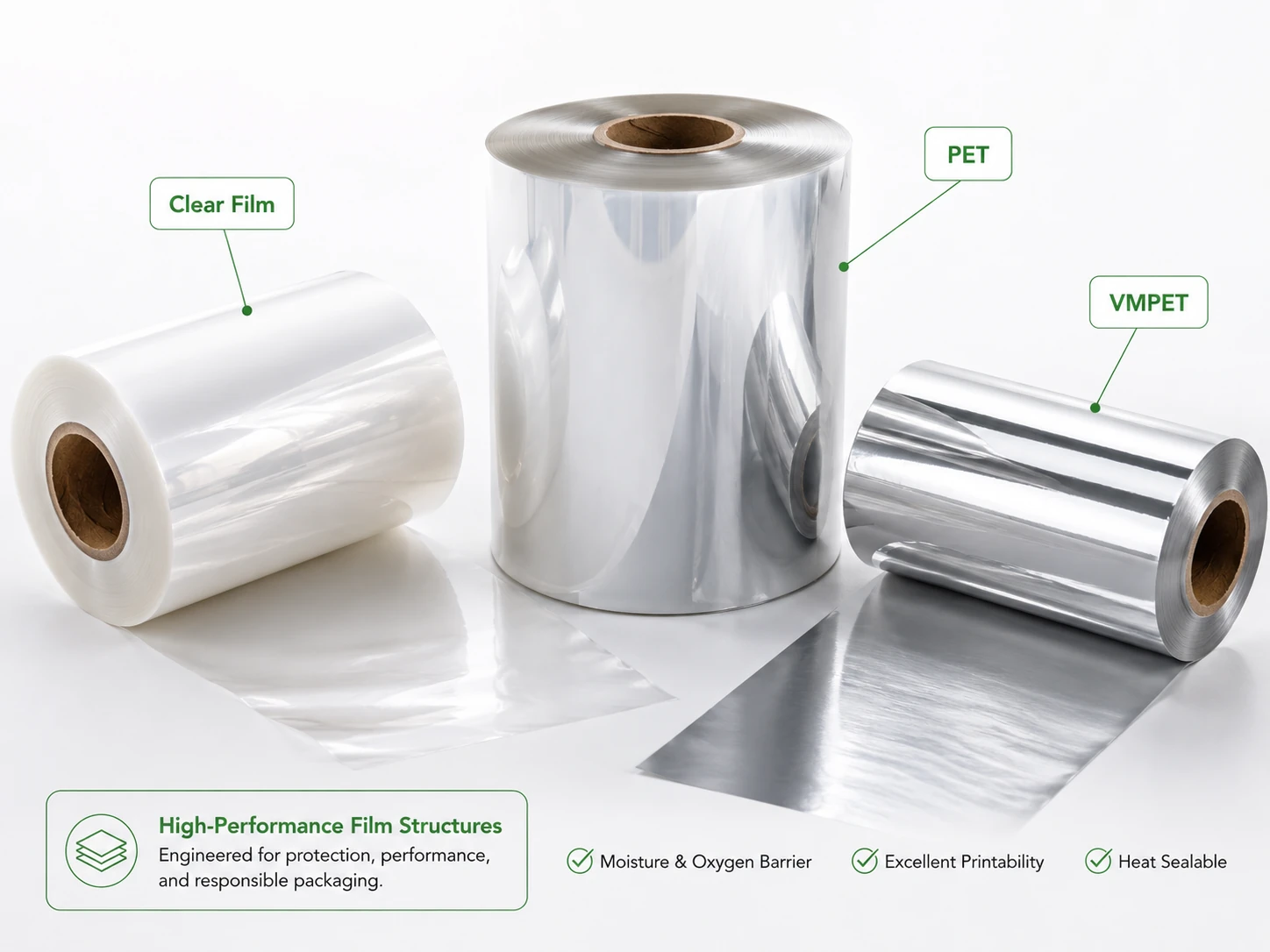
Polyethylene Terephthalate
Typical role: Outer print layer
Supports printability, stiffness, dimensional stability and surface protection.
Limitation: Not normally used as the primary heat-seal layer.
Polyethylene
Typical role: Inner seal layer
Provides heat sealing, flexibility, moisture resistance and product contact.
Limitation: Standard PE alone provides limited oxygen barrier.
Polyamide / Nylon
Typical role: Strength layer
Improves puncture resistance, toughness and drop performance.
Limitation: Adds complexity and is not needed in every structure.
Aluminum Foil
Typical role: High-barrier layer
Provides strong protection from oxygen, moisture, light and aroma loss.
Limitation: Opaque and more difficult to recycle in conventional plastic streams.
Vacuum-Metallized PET
Typical role: Barrier layer
Balances improved barrier, metallic appearance, lower weight and cost.
Limitation: Should not be treated as equivalent to real aluminum foil.
This quick overview is useful, but customers normally make decisions based on complete laminate structures, not isolated material names. That is why the next step is understanding how the layers work together.
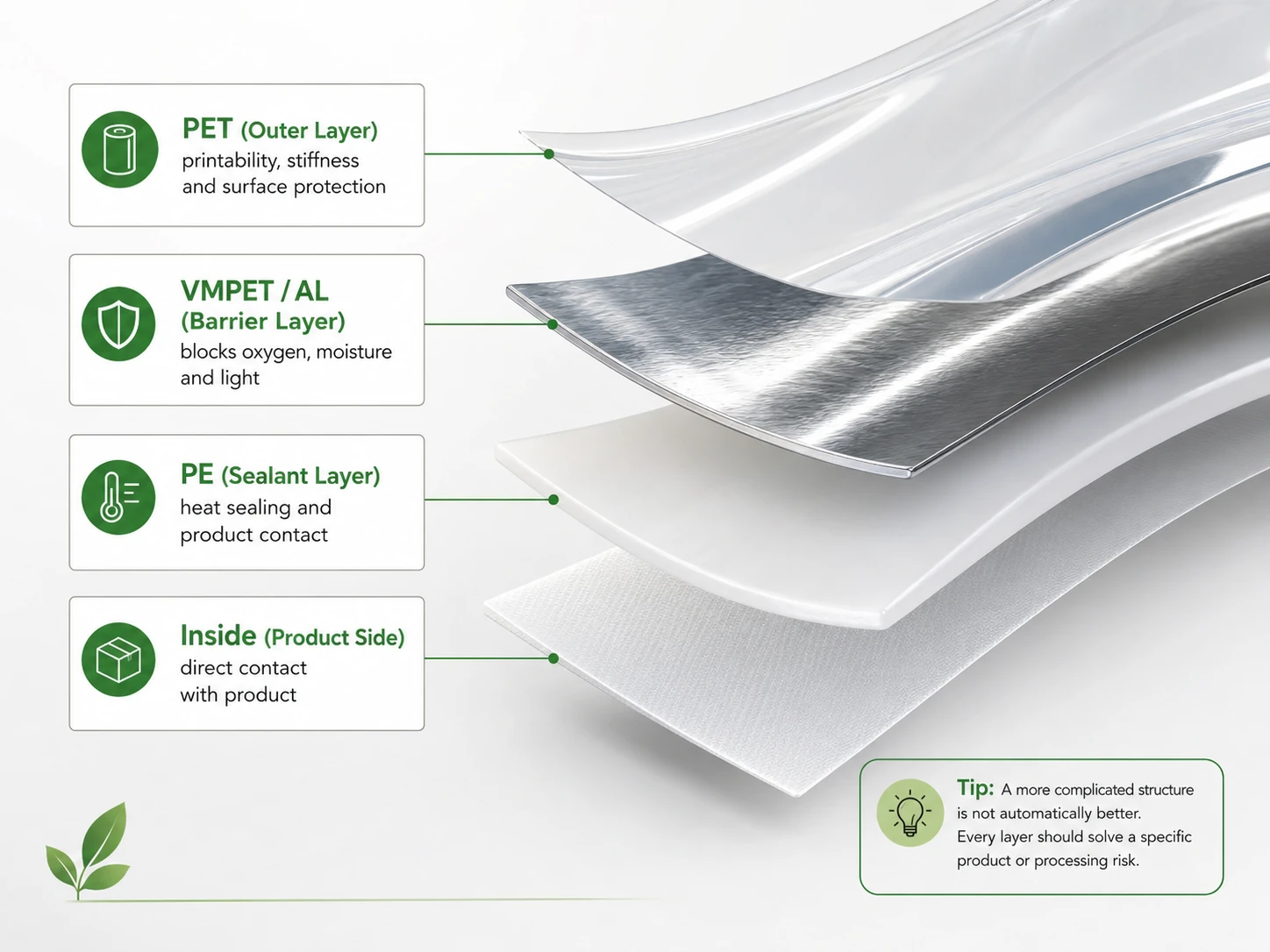
Different Layers Work Together to Protect the Product
A single film rarely provides the ideal combination of printability, strength, barrier protection and sealability. Flexible packaging therefore often combines multiple layers, each with a specific function.
A typical structure such as PET / VMPET / PE may be understood like this:
- PET — outer print layer for graphics, stiffness and surface protection
- VMPET or AL — middle barrier layer to reduce oxygen, moisture and light transmission
- PE — inner seal layer for leak resistance and product contact
The pouch format also affects performance. For example, a flat-bottom pouch and a stand-up pouch may use similar laminates, but their gusset structure, filled-pack stability and sealing stress can be quite different.
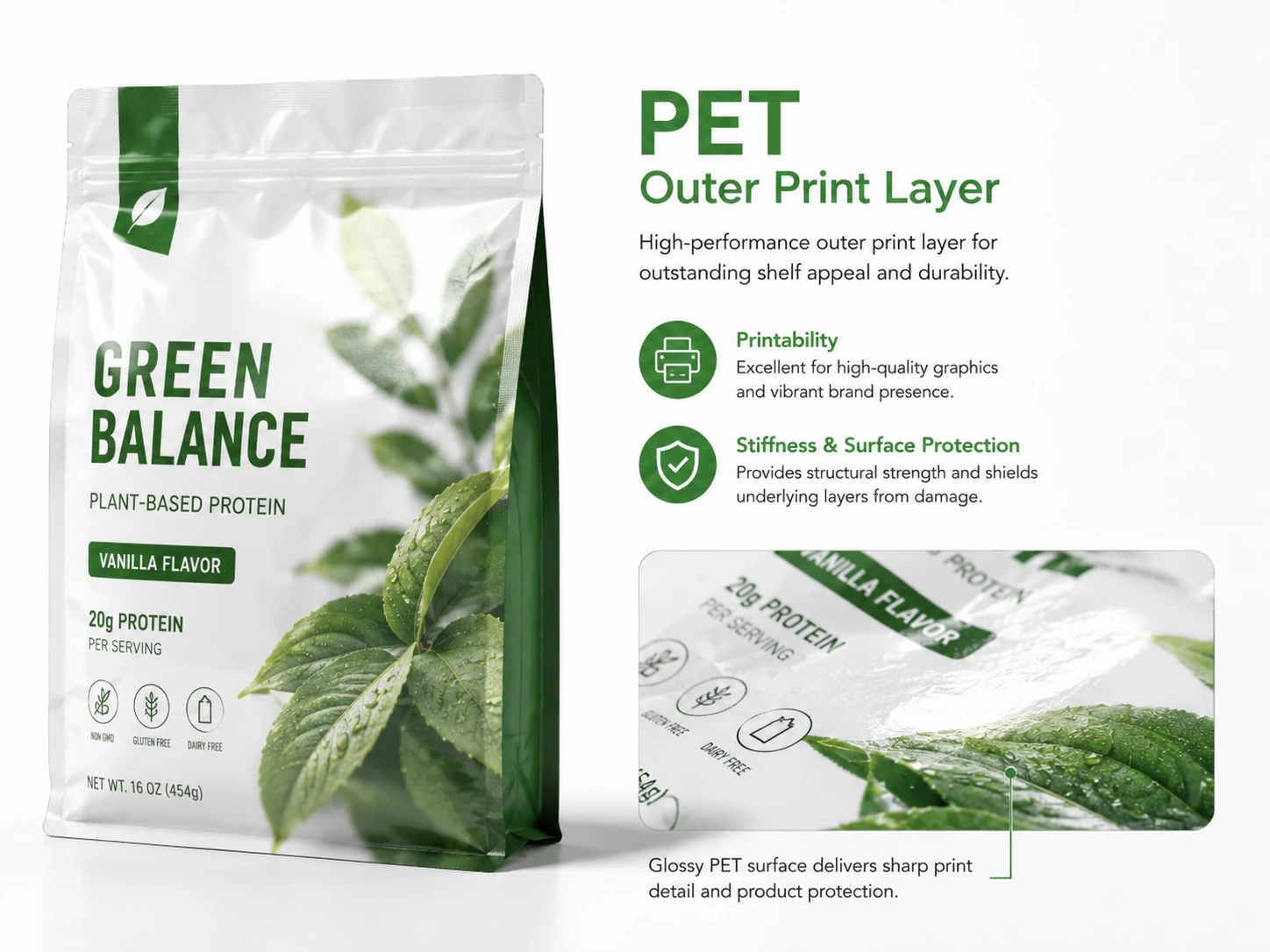
PET — The Outer Print Layer
PET is widely used as the outer layer of laminated flexible packaging because it provides a stable surface for printing and helps the finished pouch retain a clean, professional appearance.
It commonly supports high-quality graphics, good dimensional stability and resistance to scuffing during conversion and handling. PET is frequently used on printed stand-up pouches, flat-bottom bags and various custom retail formats.
It may be a practical starting point for less-sensitive dry products, shorter distribution cycles and packages that do not require demanding oxygen or light barrier performance.
PE — The Heat-Seal and Contact Layer
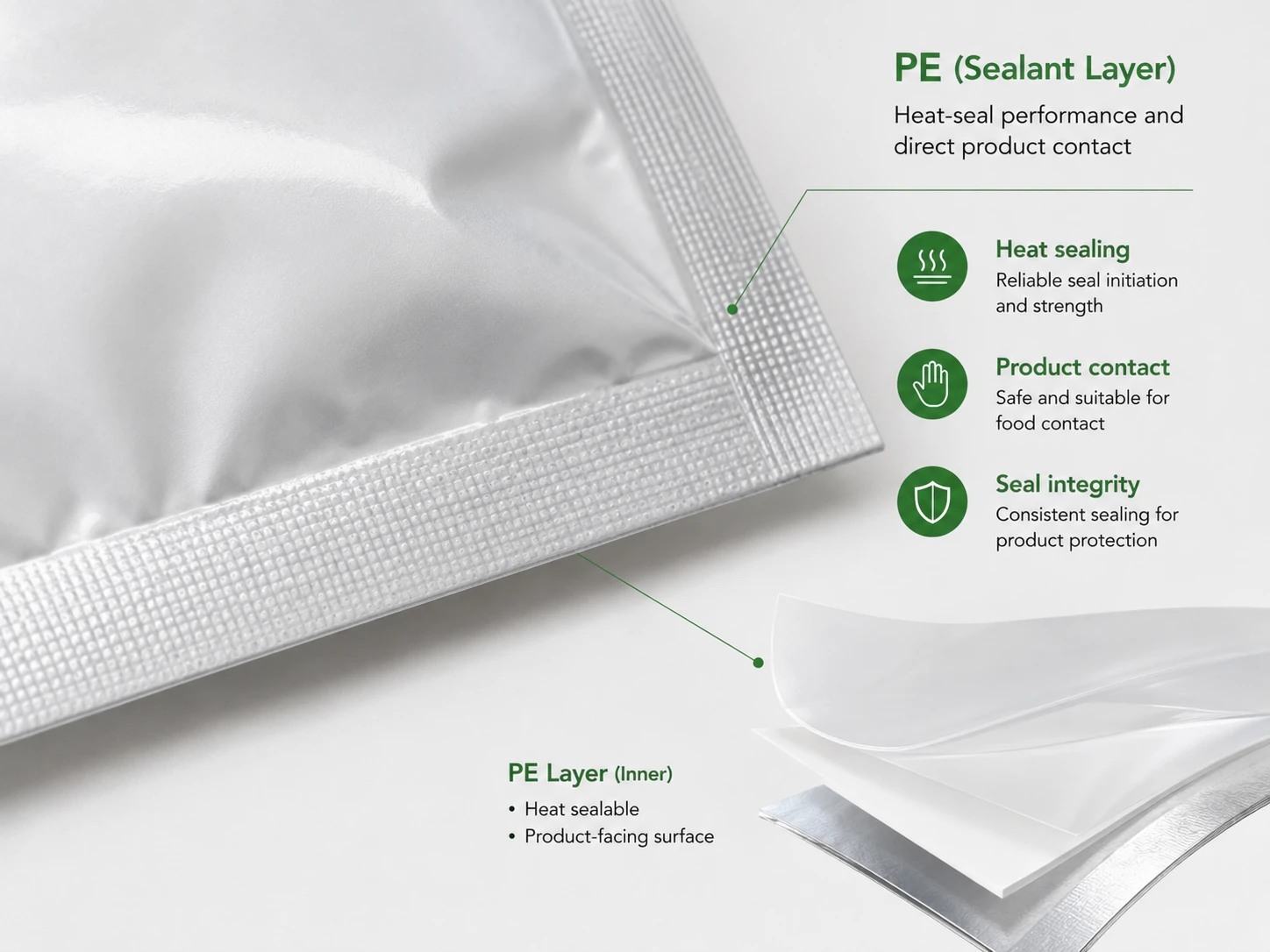
PE is commonly placed on the inside of a flexible package because it provides heat sealing, flexibility and a suitable product-contact surface. It is also a broad material family rather than one single film type.
The exact PE grade can affect seal-initiation temperature, hot tack, seal strength and packaging-machine performance. This is especially important for automatic applications such as VFFS or HFFS packaging.
For automatic filling projects, it is helpful to review film behavior together with the converting method. See the guide to custom printed rollstock film for related production considerations.
PA — The Strength and Puncture Layer
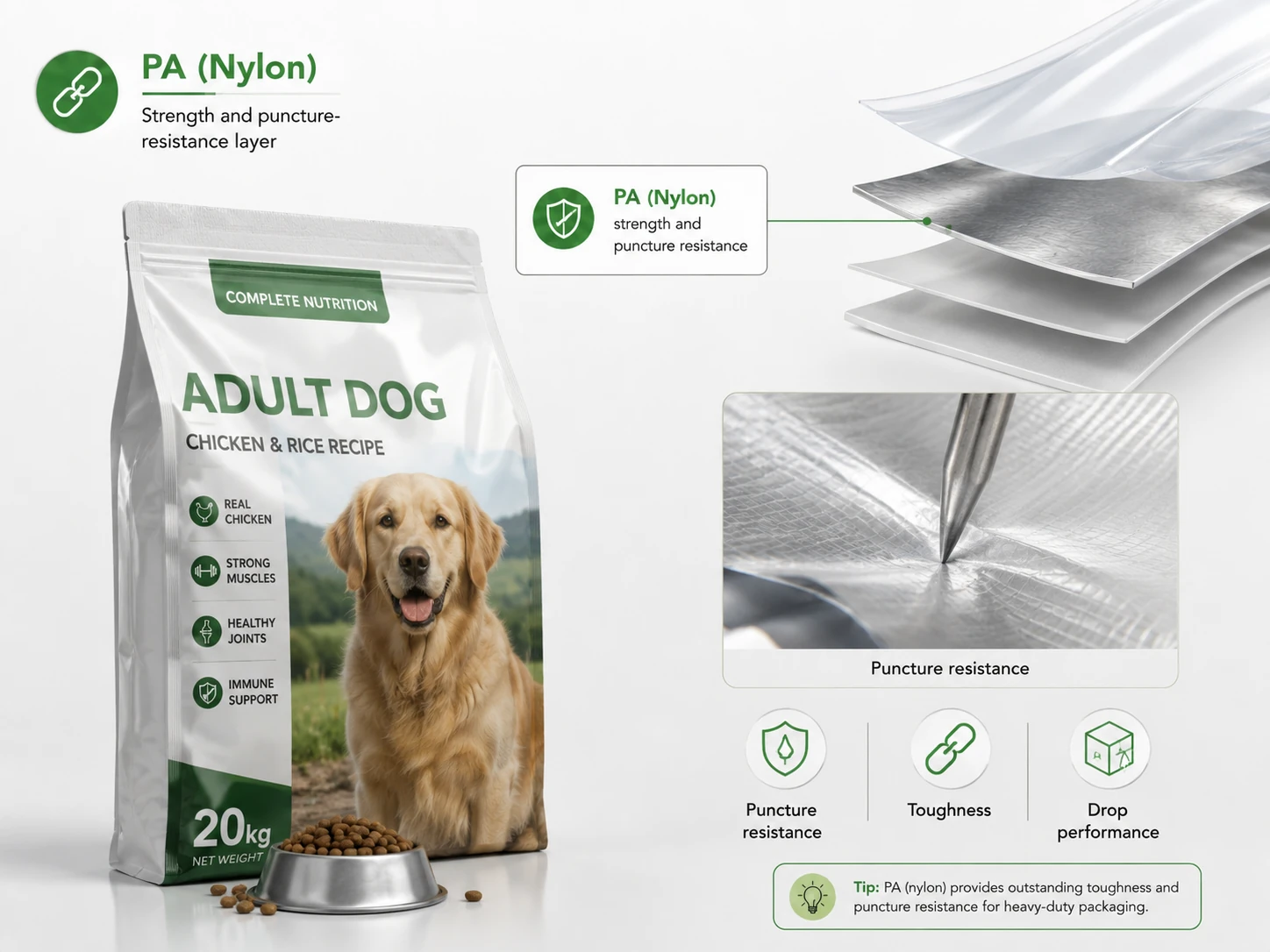
PA, also called nylon, is commonly added when a pouch needs improved toughness, puncture resistance and drop performance. It can be useful for heavy products, sharp-edged products, frozen foods, vacuum packaging and some liquid or refill applications.
PA should not be added by default. It is most valuable when the product or shipping conditions create a measurable mechanical risk that a simpler structure may not handle well.
Once the basic roles of PET, PE and PA are clear, the next question is usually about barrier. That is where customers most often compare AL and VMPET.
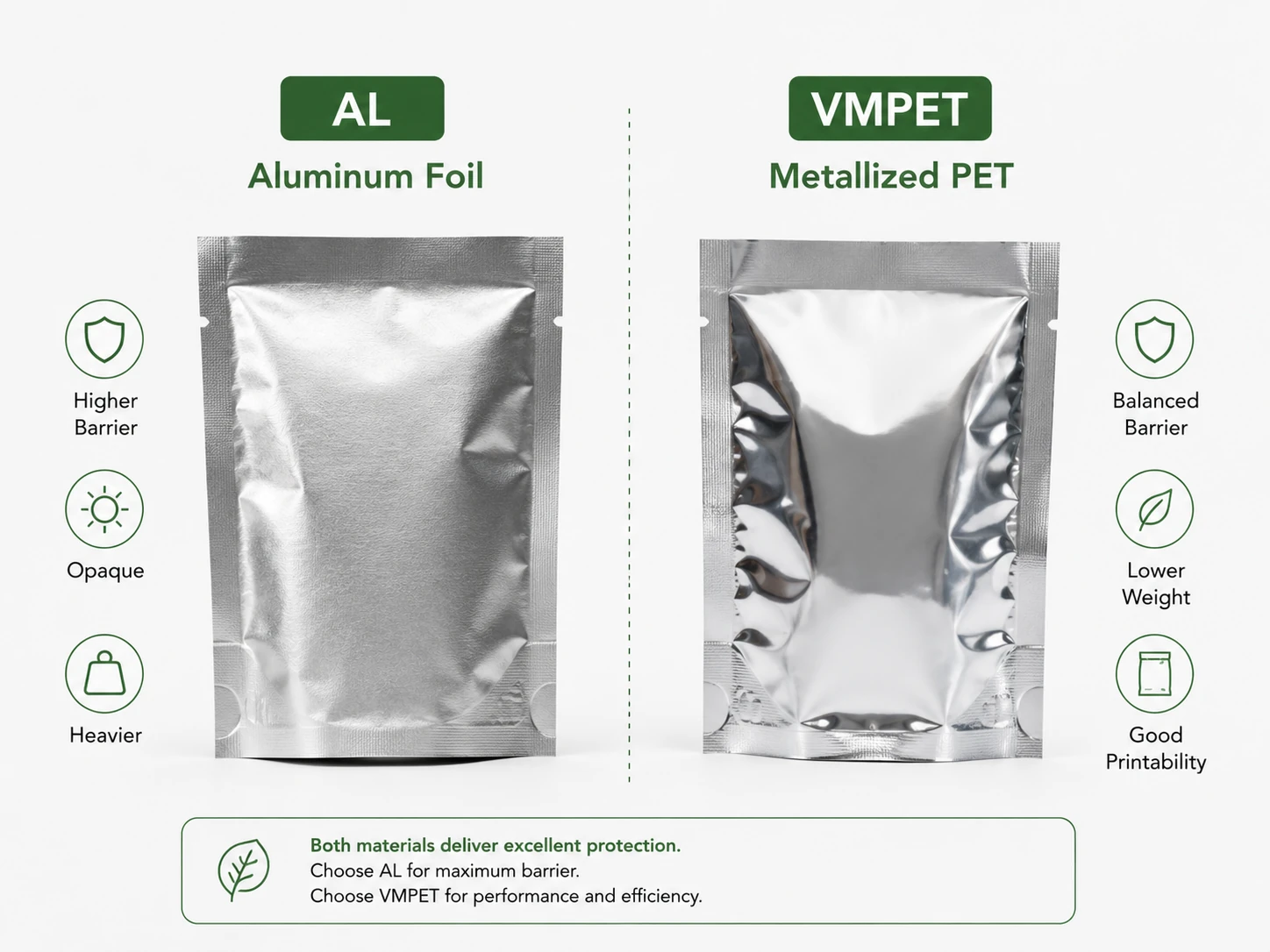
Do Not Treat AL and VMPET as the Same Material
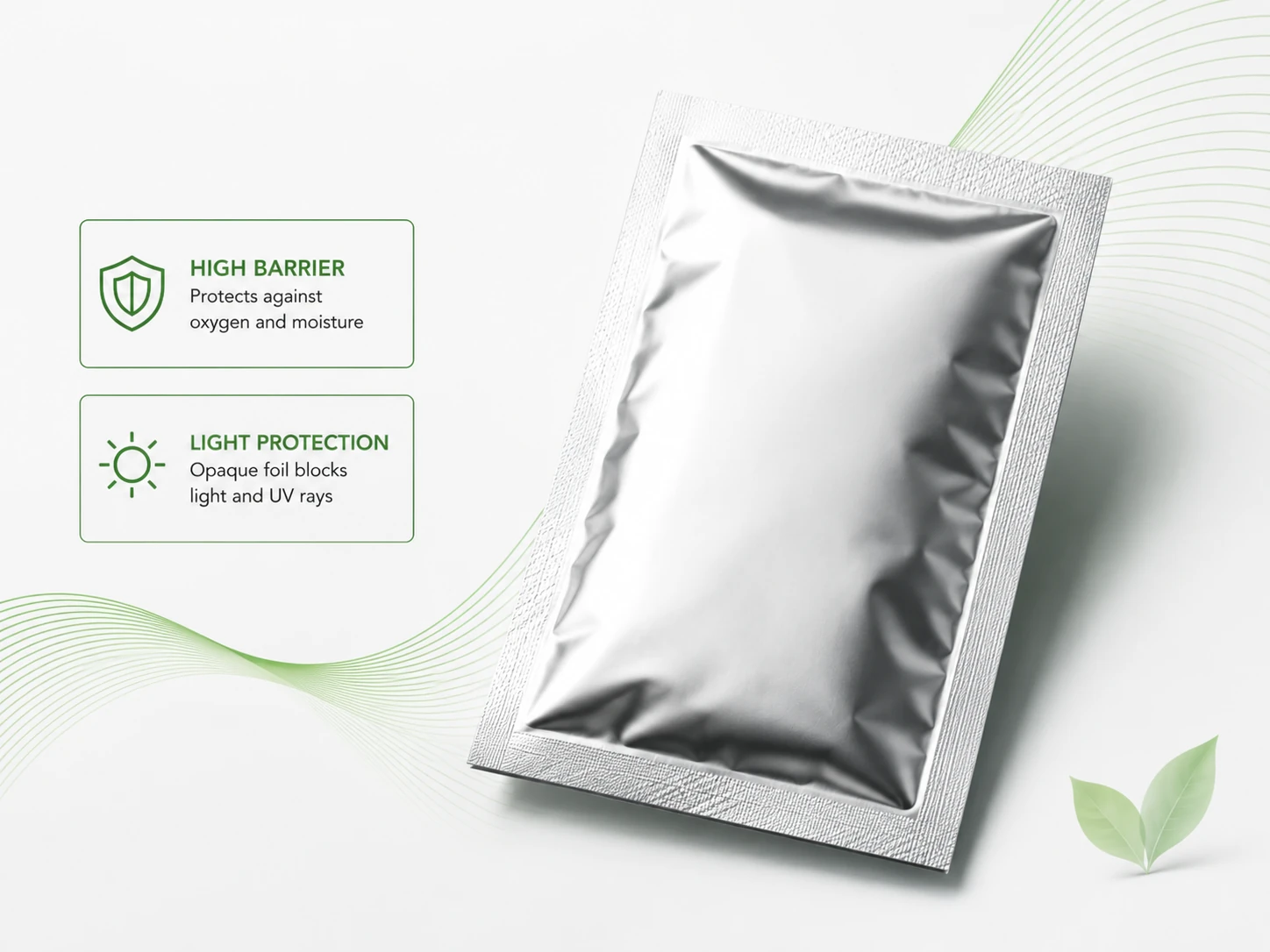
AL means a real aluminum foil layer laminated between plastic films. When intact and correctly converted, it can provide very strong protection against oxygen, moisture, light and aroma loss.
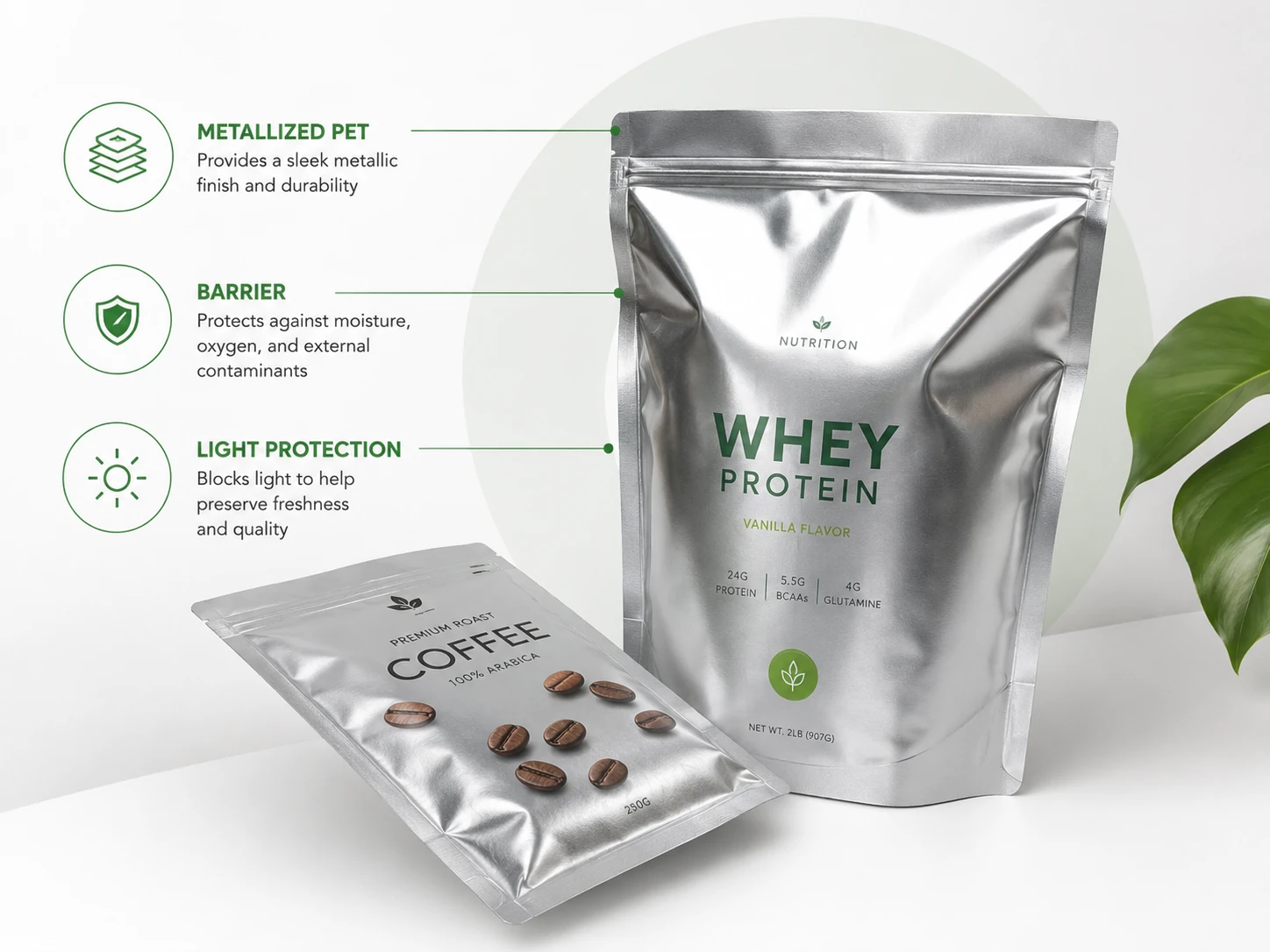
VMPET is PET film coated with a very thin aluminum layer in a vacuum metallization process. It usually offers better barrier than clear PET while remaining lighter and often more economical than solid foil.
| Comparison | AL (Aluminum Foil) | VMPET (Metallized PET) |
|---|---|---|
| Material construction | Separate solid aluminum foil | Metallized polyester film |
| Barrier performance | Usually higher when intact | Moderate to high depending on grade |
| Weight | Higher | Lower |
| Cost | Usually higher | Usually lower |
| Transparency | Opaque | Metallic, not transparent |
| Typical use | Sensitive powders, higher-barrier products, longer shelf-life projects | Coffee, snacks, tea, spices, protein powder and dry foods |
For many dry food and powder applications, VMPET can provide the right balance between barrier and cost. For highly sensitive products or longer shelf-life requirements, aluminum foil may be more appropriate. What matters is matching the actual barrier need to the product.
For general materials background, ASTM and other testing references are useful when evaluating barrier claims, including ASTM D3985 for oxygen transmission and ASTM F1249 for water-vapor transmission.
Compare Common Structures by Their Function and Typical Use
Below are several common laminate structures used in flexible packaging. These are practical starting points, not fixed rules. Real product selection should still consider fill weight, shelf life, machine conditions and product sensitivity.
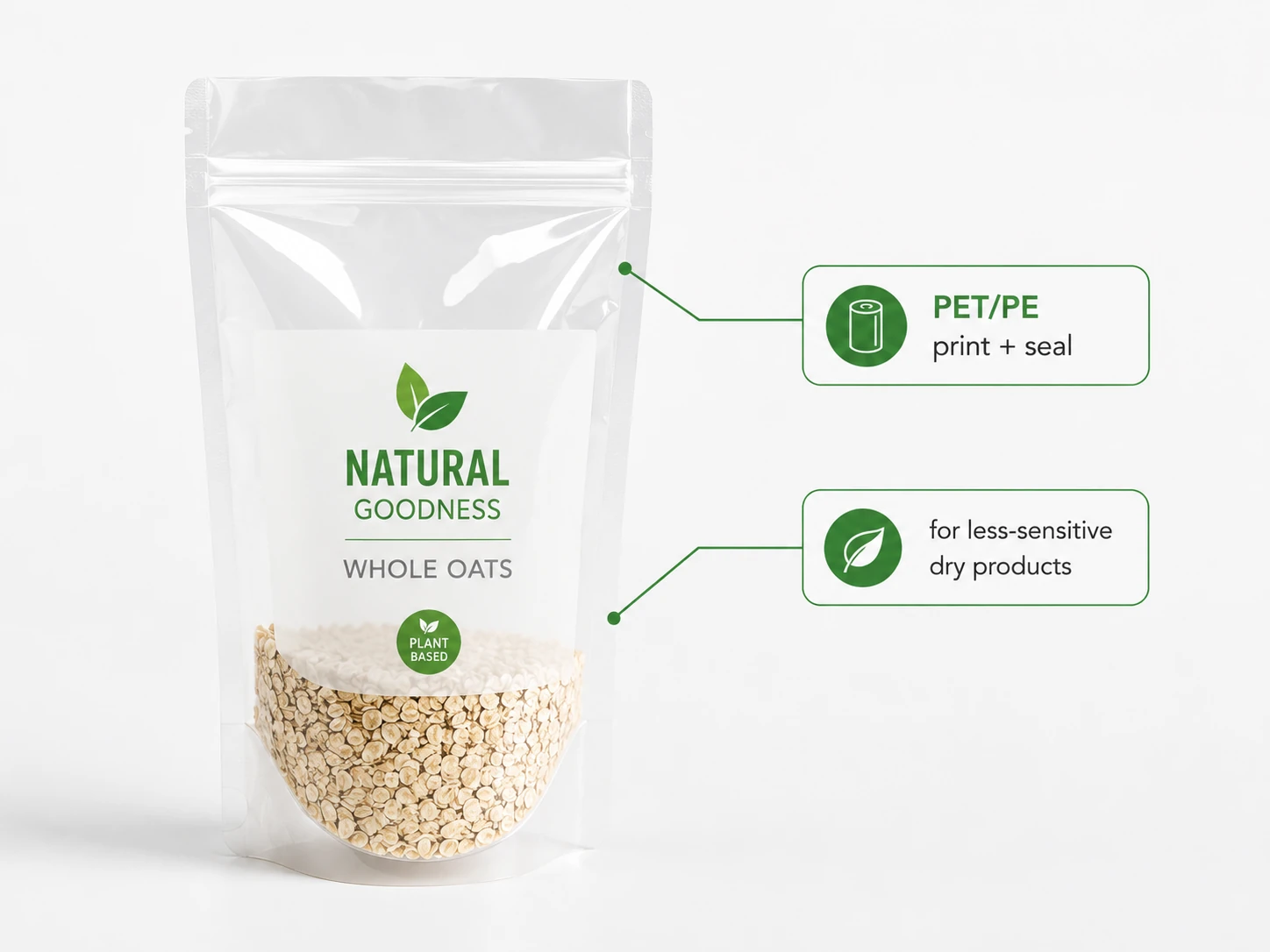
PET / PE
Best for: less-sensitive dry products, transparent packaging, shorter shelf-life projects.
Typical benefit: good printability with straightforward sealing.
Verify: seal strength, product compatibility and actual barrier needs.
PET / VMPET / PE
Best for: coffee, tea, snacks, spices, nuts, powders and pet treats.
Typical benefit: practical balance of barrier, metallic appearance and cost.
Verify: OTR, WVTR, metallization quality and seal performance.
PET / AL / PE
Best for: sensitive powders, supplements, ground coffee, spices and light-sensitive products.
Typical benefit: strong barrier against oxygen, moisture and light.
Verify: foil integrity, pinhole control, flex resistance and shelf-life target.
PA / PE
Best for: vacuum packaging, frozen foods, liquids and transparent heavy-duty packs.
Typical benefit: puncture resistance with heat sealing.
Verify: puncture performance, seal strength and temperature-related handling conditions.
PET / PA / PE
Best for: larger pouches, heavy products, pet food and refill packaging.
Typical benefit: combines printed presentation with added mechanical strength.
Verify: drop testing, filled-pouch stability and actual need for the PA layer.
Mono-PE (when applicable)
Best for: projects prioritizing compatibility with selected PE recycling streams.
Typical benefit: simpler material family for specific sustainability targets.
Verify: whether barrier, machine performance and shelf-life requirements are still met.
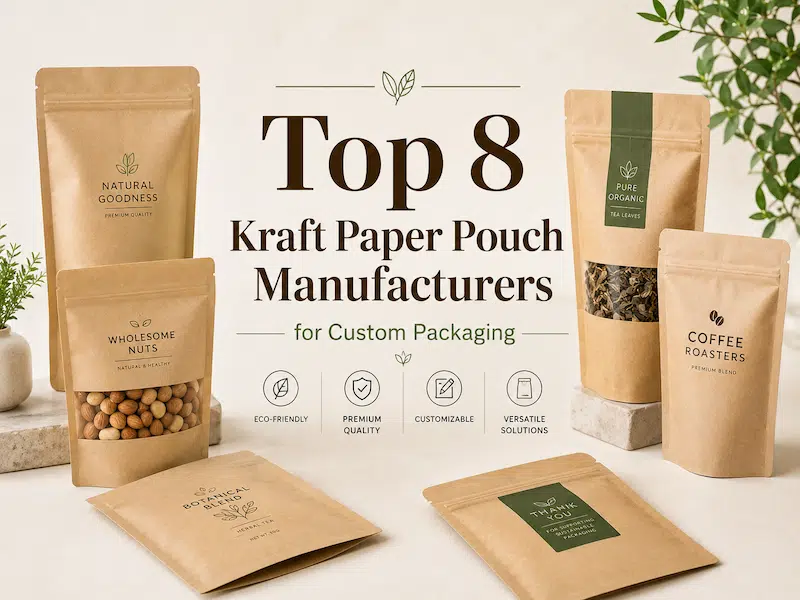
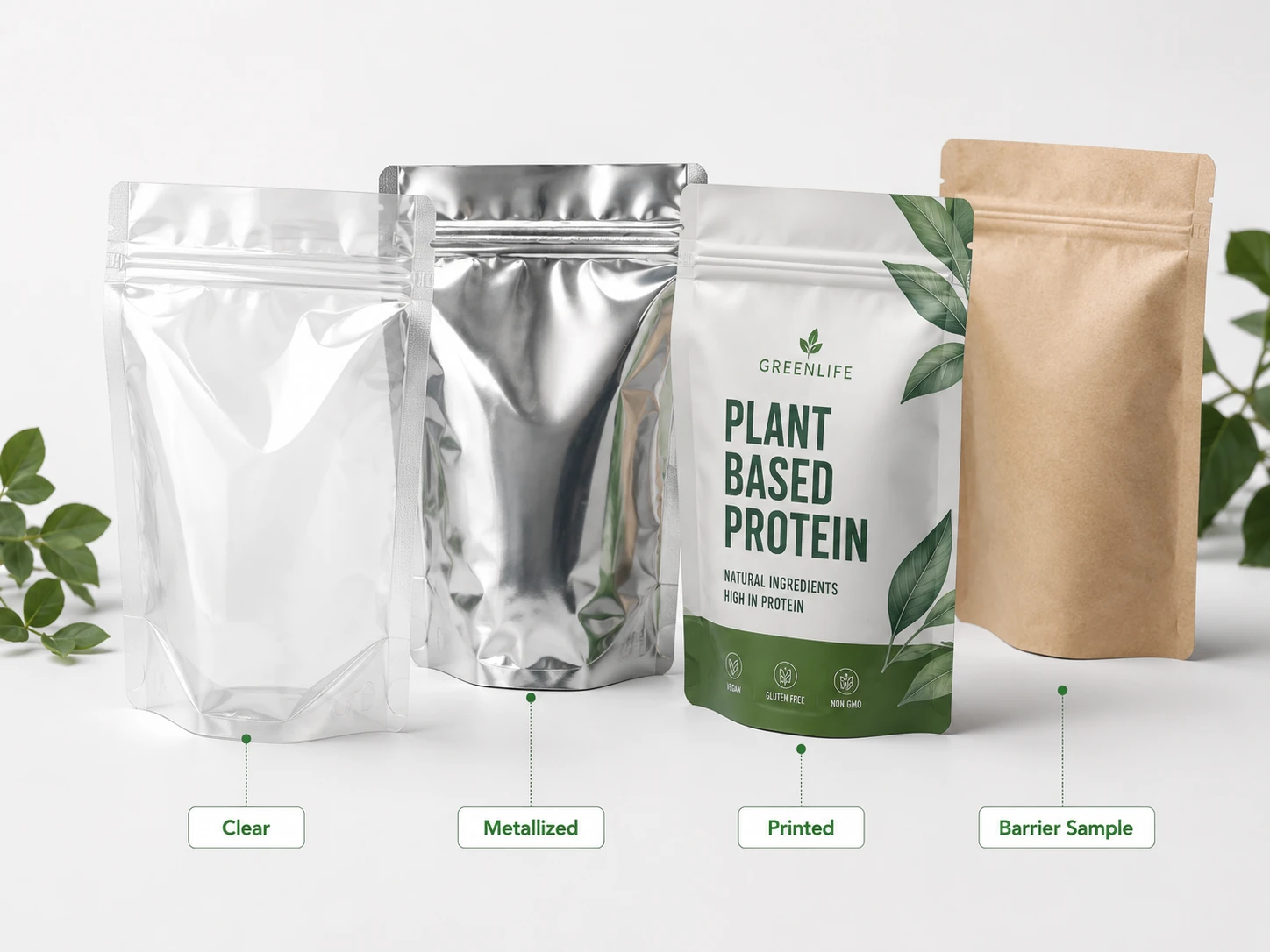
Seeing real converted pouches is useful because the same material abbreviation can produce a different appearance and feel depending on film thickness, surface finish, printing method and pouch construction.
Use Product Risk to Narrow Down the Starting Structure
| Product | Main Packaging Risk | Possible Starting Structure | What Should Be Tested |
|---|---|---|---|
| Coffee beans | Oxygen, aroma loss and light | PET/VMPET/PE or PET/AL/PE | OTR, WVTR, valve and seal performance |
| Ground coffee | Fast oxidation and aroma loss | PET/AL/PE | Barrier and shelf life |
| Tea and spices | Moisture, light and aroma loss | PET/VMPET/PE | Aroma retention and seal integrity |
| Protein powder | Moisture and seal contamination | PET/VMPET/PE or PET/AL/PE | WVTR and contaminated seal performance |
| Frozen food | Cold impact and puncture | PA/PE | Frozen-drop and seal performance |
| Pet food | Weight, grease and puncture | PET/PA/PE or reinforced high-barrier laminate | Drop, puncture and shelf life |
| Sauces and liquids | Leakage and compatibility | PET/PA/PE or application-specific laminate | Burst, seal and compatibility tests |
A Simple Seven-Step Decision Process
Many buyers compare films by cost or thickness first, but a more reliable selection process starts with product risk and processing requirements. The following decision path helps avoid unnecessary trial and error.
Identify the Main Risk
Is the product mainly affected by oxygen, moisture, light, leakage, puncture or temperature?
Define Shelf Life
State the required shelf life together with storage temperature and humidity conditions.
Confirm Transparency
Does the product need visibility, or should the package block light?
Check Mechanical Stress
Review weight, shape, sharp edges, drops and transport conditions.
Confirm Filling Method
Manual filling, VFFS, HFFS, vacuum, frozen or hot-fill processes all affect the structure.
Add Functional Features
Zippers, valves, spouts, tear notches and laser scores may influence material selection.
Validate the Structure
Review technical data, samples and production trials before final approval.
Match the Pouch Format Too
For single-use applications, a three-side seal pouch may be more suitable than a stand-up format.
Thickness Alone Does Not Define Packaging Performance
Two pouches with the same total thickness can perform very differently. What matters is how the structure is built and what each layer contributes.
- material combination;
- individual layer thickness;
- resin grade;
- adhesive system;
- barrier coating or foil layer;
- lamination quality;
- sealant performance;
- pouch construction and handling stress.
This distinction is important when comparing quotations. A lower-cost pouch may use a similar total thickness but a weaker barrier or less suitable sealant. A more expensive structure may be justified only when the product risk truly requires it.
Confirm the Structure with Data and Application Trials
Material abbreviations do not replace testing. Good packaging decisions are supported by performance data and real production trials.
OTR
Oxygen Transmission Rate
Relevant for products affected by oxidation, rancidity, aroma loss or color change.
WVTR
Water Vapor Transmission Rate
Important for powders, snacks and moisture-sensitive products that may clump or lose texture.
Seal Strength
Confirms whether the finished pouch can remain closed during filling, stacking and transport.
Filling-Machine Trial
Checks tracking, friction, sealing consistency, cutting and registration on the actual line.
For technical references, many suppliers and converters use standards such as ASTM D3985 for oxygen transmission and ASTM F1249 for water-vapor transmission.
What Information Should You Send for a Material Recommendation?
Quotations are much more useful when they are based on the actual product and process. Before requesting a recommendation, prepare the following information:
If your project involves coffee packaging, automatic filling or specialized pouch types, it can also be helpful to review related pages on rollstock film, stand-up pouches and flat-bottom pouches before confirming the structure.
Send your product type, fill weight, pouch size, filling method and expected shelf life. GCLPacking can help review practical structure options before sampling.
Frequently Asked Questions About Flexible Packaging Materials
What is the best material for flexible packaging?
There is no universal best material. The correct structure depends on the product’s sensitivity to oxygen, moisture and light, as well as its weight, filling process, storage conditions and required shelf life.
What does PET/PE mean?
PET/PE is a two-layer laminate. PET typically provides printability and structural support, while PE provides heat sealing and product contact.
Is VMPET the same as aluminum foil?
No. VMPET is PET coated with a very thin deposited aluminum layer. Aluminum foil is a separate metal layer and normally provides different barrier performance.
Which structure is suitable for powder packaging?
PET/VMPET/PE and PET/AL/PE are common starting points for moisture-sensitive powders. The final choice depends on shelf-life requirements, sealing conditions and product sensitivity.
Is a thicker pouch always better?
No. The full material structure, resin grade, barrier layer, sealant and lamination quality usually matter more than total thickness alone.
What if recyclability is part of the project requirement?
When recyclability is important, mono-material or simplified structures may be considered, but only if they still meet the required barrier, sealing and shelf-life performance. Guidance such as CEFLEX design recommendations can be useful for broader sustainability planning.