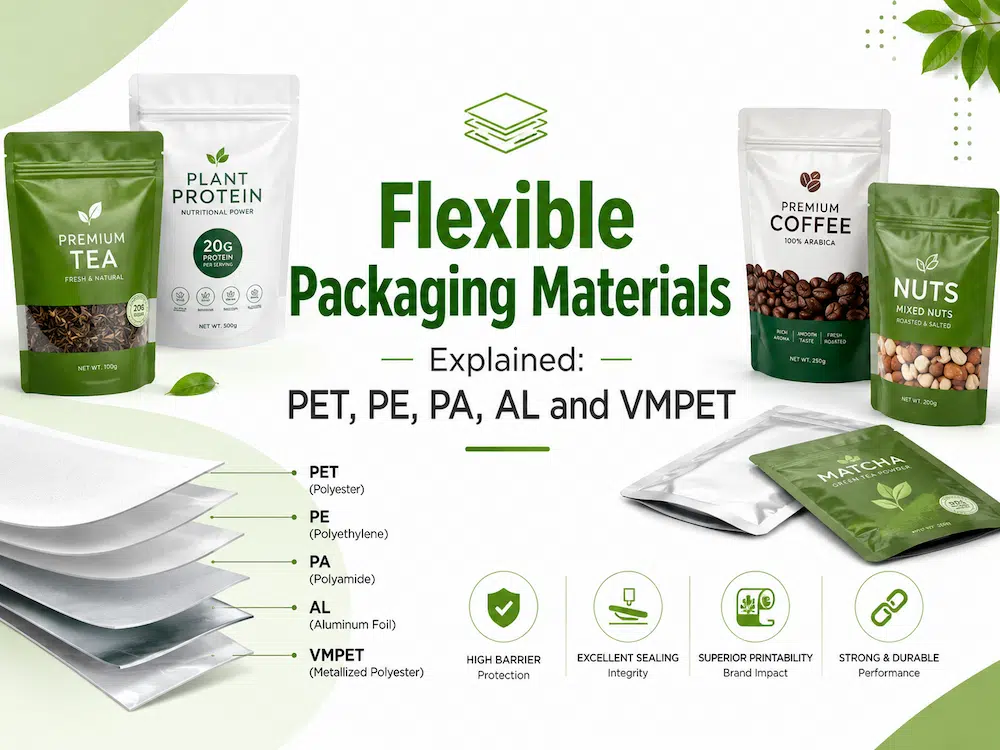

Custom printed stand up pouches usually become important at a very specific moment.
Your product is no longer just an idea. You may have already tested it with stock pouches, seen sales start to grow, or received requests from retailers, distributors, or private label customers for packaging that looks more professional. At the same time, your current sticker labels may begin to feel limited—too small for your message, too temporary for your brand, or too difficult to manage across different flavors and product lines.
That is when brands start looking for custom printed stand up pouches.
The question is rarely, “Can I print my logo on a pouch?” Of course you can. The harder questions are more practical:
- Which printing method makes sense for my quantity?
- How do I prepare artwork so it prints correctly?
- What if I have five flavors or several sizes?
- How do I avoid color problems?
- What affects MOQ and price?
- Should I request a sample before production?
- What information does the supplier need to quote accurately?
This guide is written around those decisions. It focuses on the printing, artwork, planning, and production side of custom stand up pouch packaging, so you can move from a packaging idea to a pouch that is realistic to produce.
Start with the Packaging Problem You Are Trying to Solve
Before choosing a finish or printing method, it helps to be honest about why you want custom printed pouches in the first place.
Different brands move to custom printed stand up pouches for different reasons.
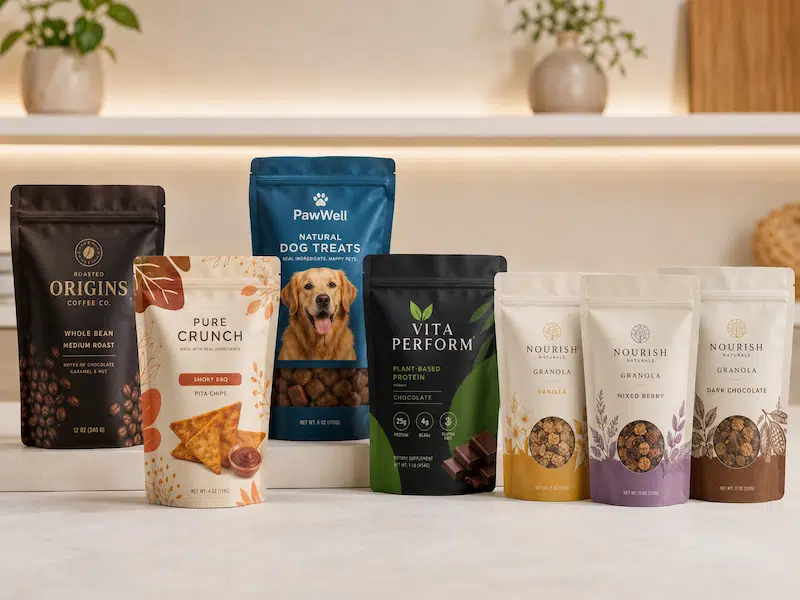
A growing coffee, snack, pet treat, or supplement brand may need stronger shelf presence, more professional packaging for Amazon or retail buyers, or a better way to avoid applying labels by hand.
For private label projects, custom printing also helps every SKU look consistent across different flavors, sizes, and product lines. In many cases, it simply gives the package more room for product information, ingredients, certifications, and usage instructions.
The reason matters because it affects the right solution.
| Your situation | What the pouch needs to solve |
|---|---|
| Your sticker labels look too basic | A cleaner, fully printed brand presentation |
| You are launching several flavors | A consistent artwork system across SKUs |
| You are preparing for retail | Clear front panel, barcode placement, shelf-ready appearance |
| You sell online | Strong first impression, durable structure, professional unboxing |
| You are building private label packaging | Repeatable design rules and easy version control |
| You want to reduce labeling work | Printed information directly on the pouch |
| Your product has compliance text | Organized back panel with enough space for required details |
Custom printing is most valuable when it solves a real business or customer problem, not just when it makes the pouch look nicer.
Stock Pouch with Label or Custom Printed Pouch?
Many brands start with stock pouches and labels, and that is not a bad thing. It is often the right choice for early testing.
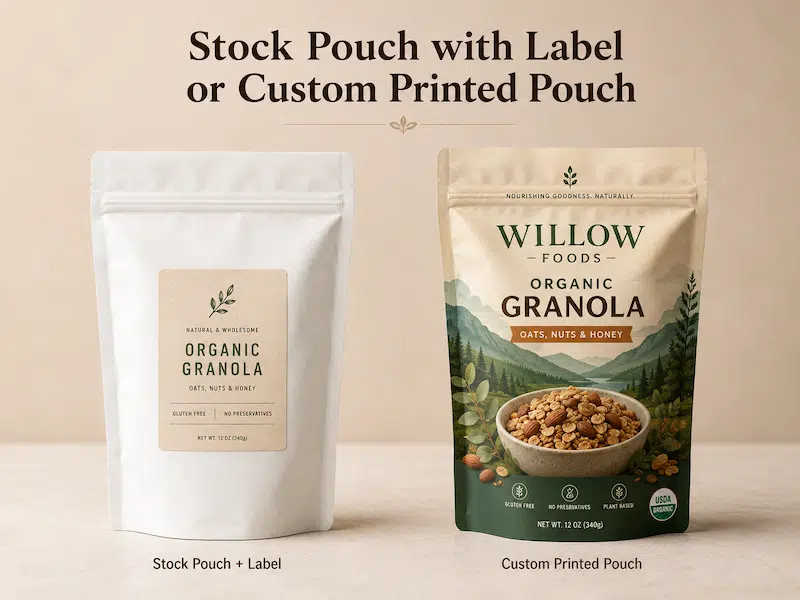
The problem appears when the product is ready for a bigger market. Labels may peel, wrinkle, limit design space, or make the package feel less polished. Applying labels also becomes time-consuming when order volume grows or when there are many SKUs.
Custom printed stand up pouches are usually a better fit once packaging needs to support sales at scale.
| Option | When it works well | When it starts to limit you |
|---|---|---|
| Stock pouch with label | Product testing, small batches, temporary packaging | Limited design space, extra labor, less polished look |
| Digital printed stand up pouch | Short runs, multiple SKUs, market testing, seasonal packaging | Unit cost may be higher for larger repeat orders |
| Gravure printed stand up pouch | Stable artwork, larger orders, long-term product lines | Higher setup cost and less flexible for frequent design changes |
If you are still changing the product every month, stay flexible. If the product is ready to look established, custom printing is worth planning.
Build the Artwork Around the Pouch, Not the Other Way Around
One of the most common mistakes in stand up pouches design is treating the pouch like a flat poster.
A stand up pouch has a real shape.
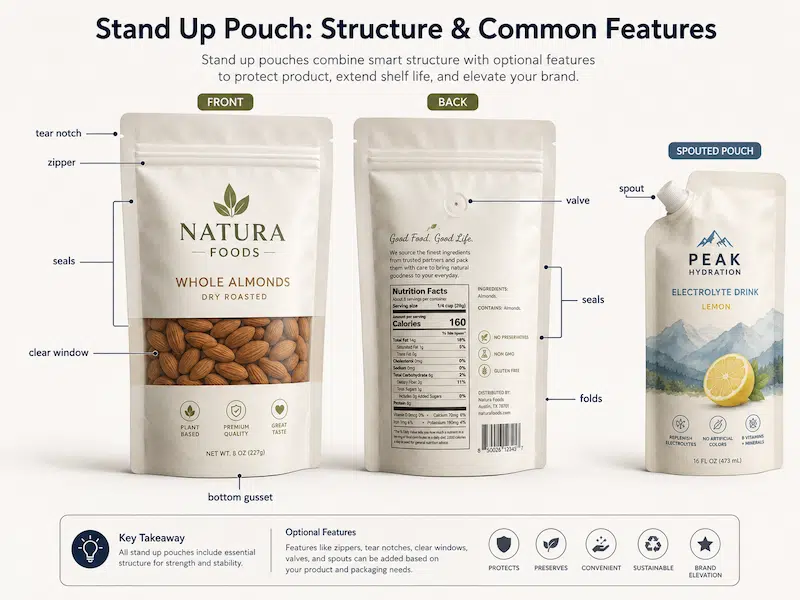
It has a front, back, bottom gusset, seals, folds, and sometimes a zipper, tear notch, clear window, valve, or spout.
Once the pouch is filled, the surface can curve, expand, or slightly change shape. This can affect how the artwork, logo, product name, and key information appear on the final package.
This is why the dieline matters in stand up pouches design.
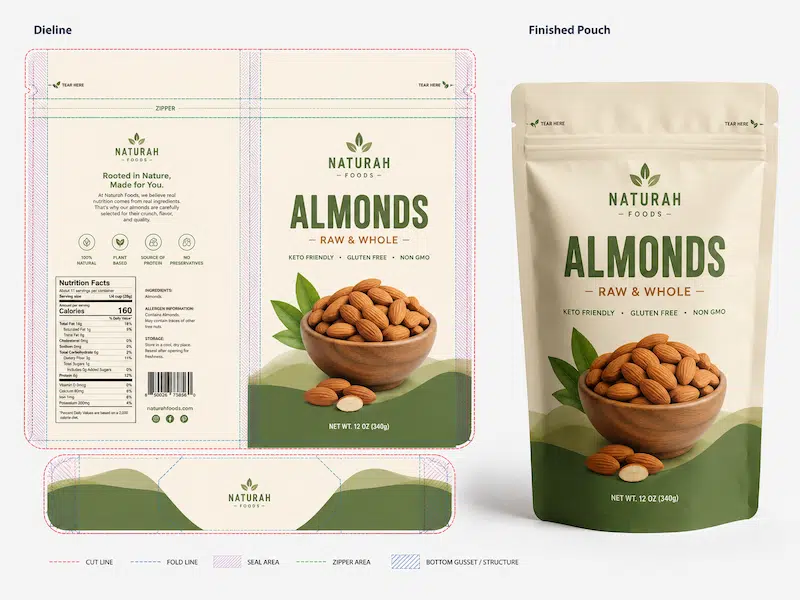
A dieline shows where the pouch will be cut, sealed, folded, and finished. It helps the designer understand where artwork can be placed safely and where important text should be avoided.
Before moving into production, the artwork should be checked in a practical way. The design should not only look good on a screen. It should also fit the pouch structure, filling condition, sealing area, and final shelf appearance.
| Artwork question | Why it matters |
|---|---|
| Is the product name readable from a normal shopping distance? | Customers should understand the product quickly. |
| Are the logo and main claim away from the seal areas? | Important elements should not be distorted or hidden. |
| Is the barcode on a flat area? | Retailers and warehouses need reliable scanning. |
| Are ingredients and required details easy to read? | Small text can become difficult on textured or dark backgrounds. |
| Is there space for batch coding or date coding? | Production coding often happens after printing. |
| Do all flavors follow the same layout rules? | The product line looks cleaner and is easier to manage. |
Print-Ready Files: What Usually Slows Projects Down
Many delays happen before production begins.
The supplier may be ready to quote or produce, but the artwork file is missing bleed, the logo is low resolution, the fonts are not outlined, the barcode is too close to a fold, or the colors are still in RGB.
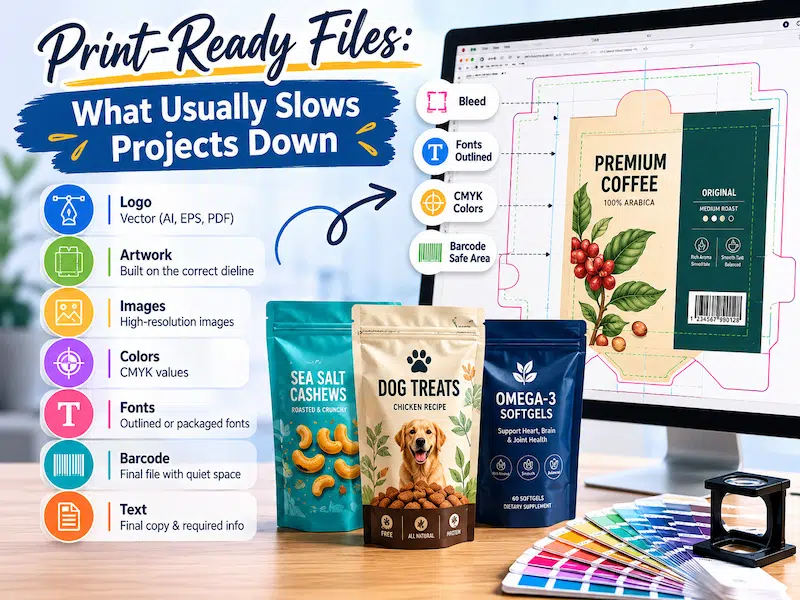
These issues are normal, especially for first-time custom packaging projects. They are also fixable if they are found early.
For smoother file review, prepare:
| File item | What to prepare |
|---|---|
| Logo | Vector format when possible, such as AI, EPS, or editable PDF |
| Artwork | Built on the correct dieline for the final pouch size |
| Images | High-resolution product images or illustrations |
| Colors | CMYK values or brand color references |
| Fonts | Outlined fonts or packaged font files |
| Barcode | Final barcode file with enough quiet space |
| Text | Final ingredients, claims, warnings, and required information |
If your artwork is not finished yet, share a reference design and product details first. GCLPacking can help confirm the pouch structure and dieline before your designer prepares final files.
Choosing Between Digital and Gravure Printing
Printing method is not only a technical choice. It affects budget, lead time, flexibility, and how easily you can manage future reorders.
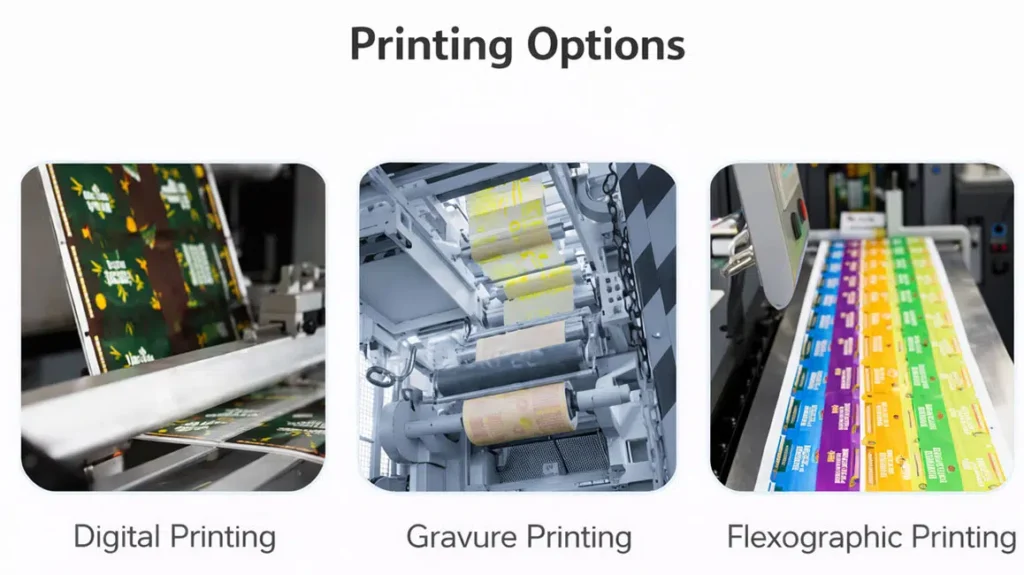
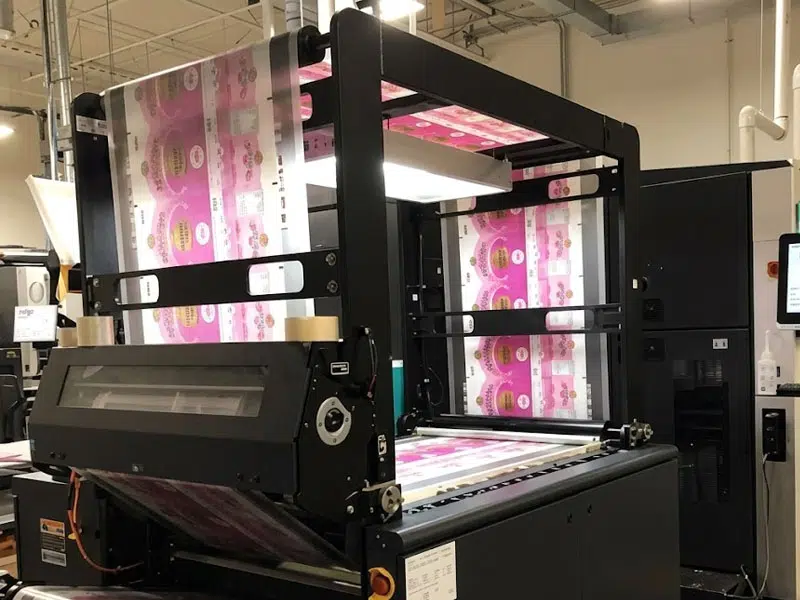
Digital printing is often better when you are launching a new product, testing several flavors, ordering a smaller quantity, or expecting artwork changes. It gives more flexibility at the start.
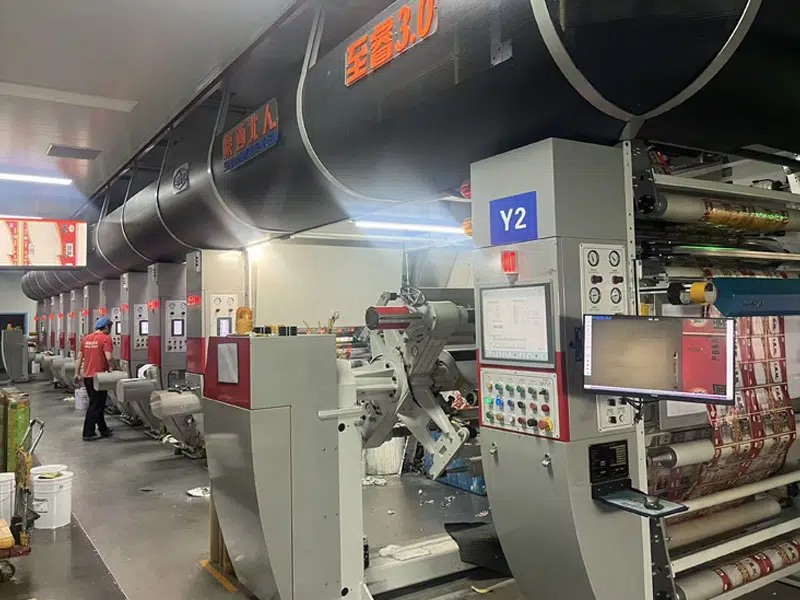
Gravure printing is usually better when you have stable artwork, higher quantity, and repeat orders. The setup cost is higher, but the unit cost can become more efficient at scale.
Flexographic printing may also be suitable for certain flexible packaging projects, depending on material, quantity, and color requirements.
| Printing method | Better for | Buyer concern it solves |
|---|---|---|
| Digital printing | New launches, short runs, many SKUs | Lower starting pressure and easier artwork flexibility |
| Gravure printing | Larger runs, repeat orders, stable designs | Strong consistency and better long-term unit cost |
| Flexographic printing | Selected medium or larger projects | A practical option depending on structure and quantity |
If You Have Multiple Flavors or SKUs
Multi-SKU packaging can become messy quickly.
At first, each flavor may feel like a separate design. But when the line grows, inconsistent layouts become harder for customers, retailers, and your own team.
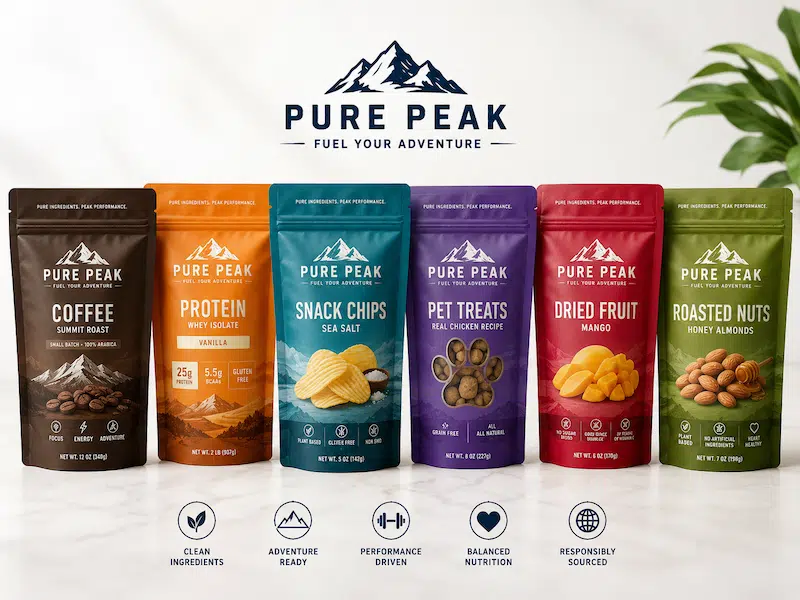
A better approach is to build a system.
Keep the main structure consistent: logo position, product name, net weight, barcode area, claim placement, and back-panel layout. Then use color, product image, flavor name, or a small pattern change to separate each version.
| Common SKU issue | Better approach |
|---|---|
| Every flavor looks unrelated | Use one layout system with controlled color changes |
| Customers cannot tell flavors apart | Make the flavor name and color cue easy to see |
| Reorders become confusing | Name files clearly by product, size, SKU, and revision |
| Retail display looks inconsistent | Keep logo, claim hierarchy, and panel structure aligned |
| Private label versions need changes | Separate fixed brand elements from editable customer elements |
This planning saves time later, especially when you add more flavors, sizes, or customer versions.
Finish and Material Should Support the Brand Message
Customers feel packaging before they fully read it.
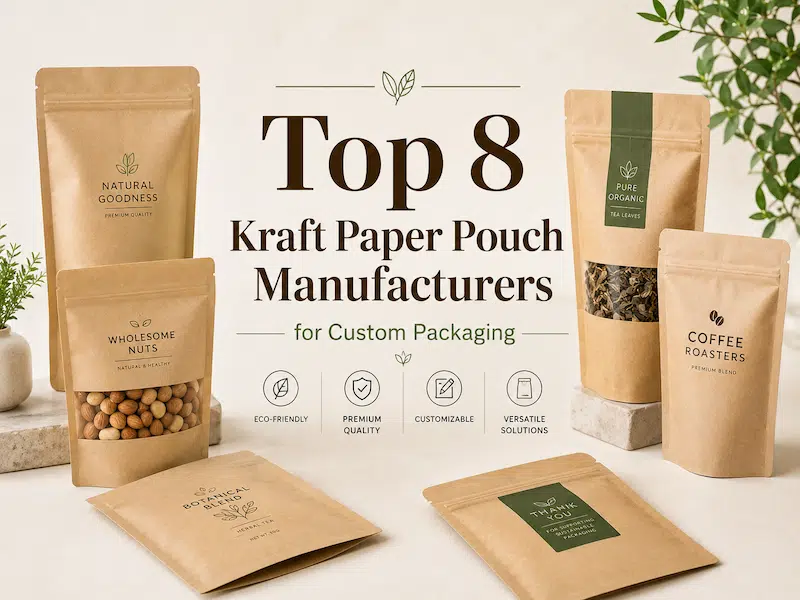
A matte finish can make the product feel clean and premium. Gloss can make colors more vivid. Kraft paper can feel natural and simple. A clear window can make the product feel honest and product-led. Metallic effects can create a stronger premium impression.
The right choice depends on the category and price point.
| Finish or look | Often works for |
|---|---|
| Matte film | Premium snacks, supplements, coffee, clean modern brands |
| Glossy film | Candy, colorful snacks, energetic retail products |
| Kraft paper look | Tea, coffee, organic foods, handmade or natural products |
| Clear window | Products where the contents help sell the product |
| Metallic effect | Specialty, premium, or high-impact packaging |
This is also where cost and performance come in. A pouch can look natural on the outside and still need a barrier layer inside. A clear window can help sales, but it must be placed where it does not weaken the design or interfere with required information.
MOQ, Price, and the Real Cost of Custom Printing
MOQ is often the first thing people ask, but it is rarely the only thing that matters.
A lower MOQ can be helpful when you are testing the market. A larger order can reduce unit cost, but it also means more inventory and less flexibility if the artwork changes.
Price depends on several connected choices.
| What affects cost | Why it changes the quote |
|---|---|
| Printing method | Digital and gravure have different setup and unit cost structures |
| Order quantity | Higher quantities usually reduce unit price |
| Number of SKUs | More versions can increase setup and file handling |
| Pouch size | Larger pouches use more material |
| Finish | Matte, kraft, metallic, or special effects can change cost |
| Features | Zipper, window, valve, spout, hang hole, and tear notch affect production |
| Shipping | Air freight and sea freight create very different landed costs |
The best choice is not always the cheapest quote. For custom printed packaging, a good quote should make sense for your launch plan, reorder plan, and product margin.
Samples: What You Should Actually Check
Samples are not just for seeing whether the pouch looks nice.
They help you check whether the pouch works.
A blank sample can confirm size, capacity, standing shape, and zipper placement. A material sample can show hand feel and finish. A digital proof can catch layout and text issues. A printed sample can help review color, finish, and overall presentation.
| Sample type | What to check |
|---|---|
| Digital proof | Text, layout, barcode, dieline alignment |
| Blank pouch sample | Size, capacity, standing shape, opening, zipper position |
| Material sample | Texture, stiffness, finish, barrier direction |
| Printed sample | Color, print quality, finish, final visual effect |
If your product has an unusual shape, low density, oily surface, sharp edges, or strict shelf life needs, sample testing becomes even more important.
Lead Time: Where Delays Usually Happen
Custom printed pouches take time because several decisions need to be confirmed before production can move smoothly.
The most common delays come from artwork revisions, unclear specifications, slow proof approval, material changes, multiple SKUs, or late compliance updates.
A smoother project usually follows this order:
- Confirm product and pouch requirements.
- Choose size, material direction, and features.
- Prepare or request the dieline.
- Build artwork on the correct template.
- Review proof and make corrections.
- Approve production.
- Plan shipping and reorder timing.
For first orders, leave more time than you think you need. For repeat orders, keep the approved artwork and specifications organized so the next run is faster.
What to Send When Asking for a Quote
If you only send “I need custom printed stand up pouches, how much?”, the supplier has to ask many follow-up questions.
You will get a better answer if you share the practical details from the start.
| Information | Helpful details |
|---|---|
| Product | Type, fill weight, texture, shelf life requirement |
| Pouch | Size, style, zipper/window/valve/spout needs |
| Printing | Number of designs, artwork status, preferred finish |
| Quantity | Estimated quantity per design or SKU |
| Sales channel | Retail, online, wholesale, distributor, private label |
| Market | Destination country or region |
| Timeline | Launch date, reorder date, or delivery deadline |
| Files | Logo, artwork, dieline, reference packaging, brand guide |
If some details are unknown, that is fine. Start with what you know. The pouches packaging supplier can help narrow the options.
How GCLPacking Can Help
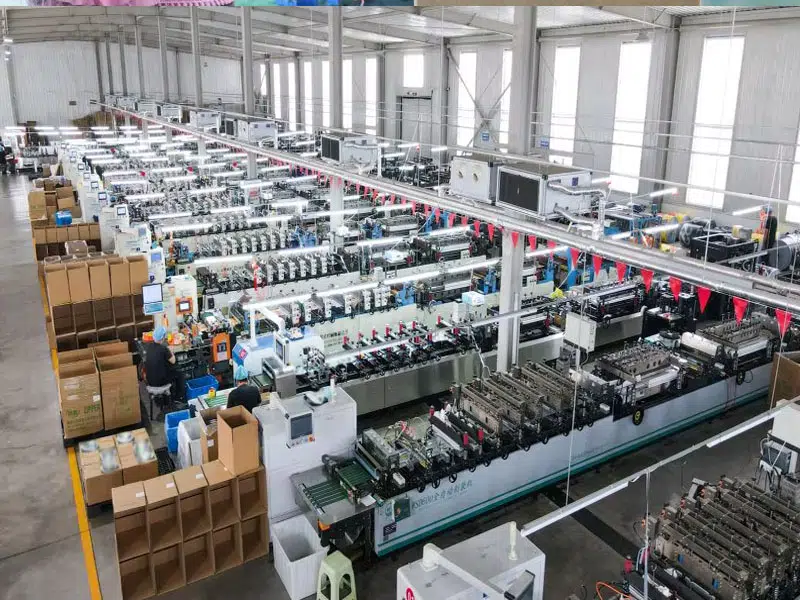
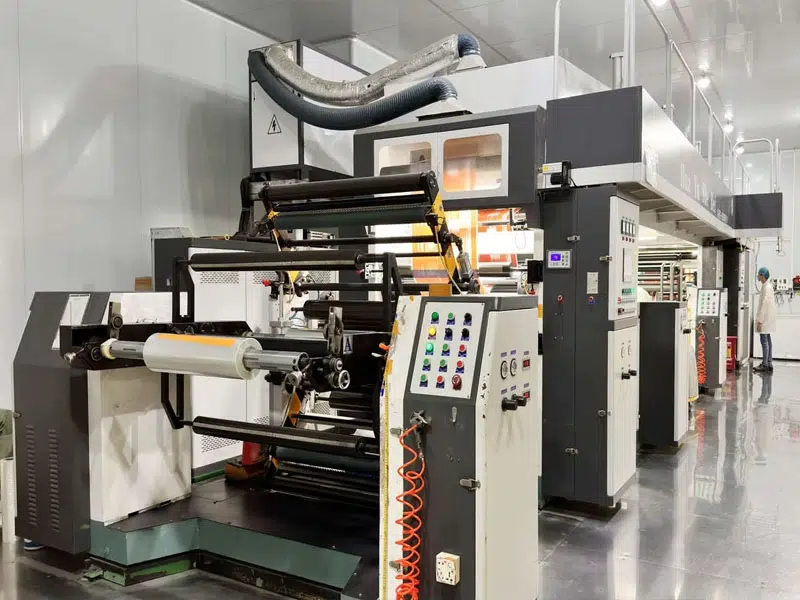
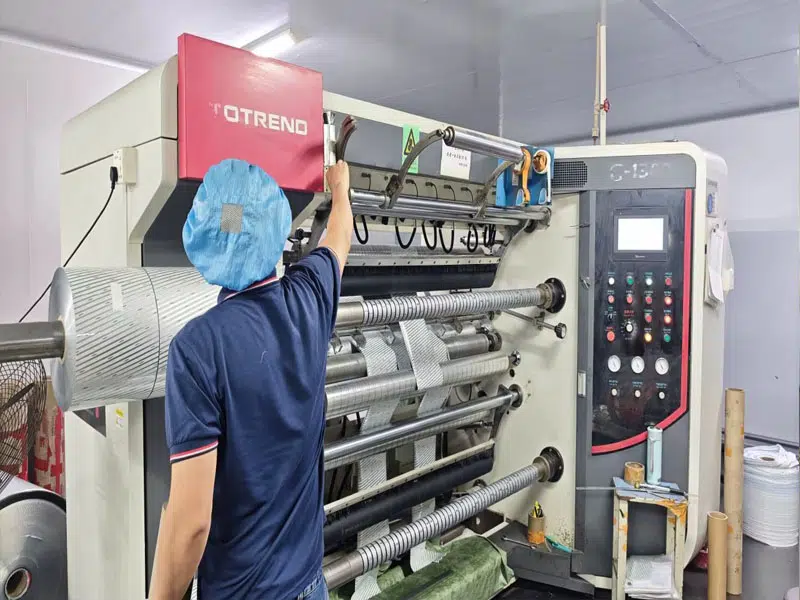
GCLPacking is a real flexible packaging factory that supports brands from design review to sample making and bulk production.
Custom printed stand up pouches involve many details, including pouch size, material structure, printing method, finish, zipper, valve, window, sealing area, and MOQ. GCLPacking helps check these details before production, so the final pouch can look professional, work properly, and stay consistent in future reorders.
| Printing Method | MOQ | Best For | Production Time |
|---|---|---|---|
| Digital Printing | 500 pcs | Small batches, new products, multiple SKUs | 7–15 business days after design confirmation |
| Gravure Printing | 10,000 pcs | Bulk orders, stable colors, long-term reorders | 7–15 business days after design confirmation |
From packaging design support and sample confirmation to mass production and quality control, GCLPacking provides a one-stop custom pouch packaging solution for coffee, snacks, pet treats, supplements, and private label products.
Final Thoughts
Custom printed stand up pouches should make the product easier to sell, easier to understand, and easier to manage as the brand grows.
Start with the real problem your packaging needs to solve. Then plan the artwork, printing method, MOQ, samples, and production details around that goal.
When the pouch is planned this way, it does more than carry the product. It helps the product feel ready for the market.