
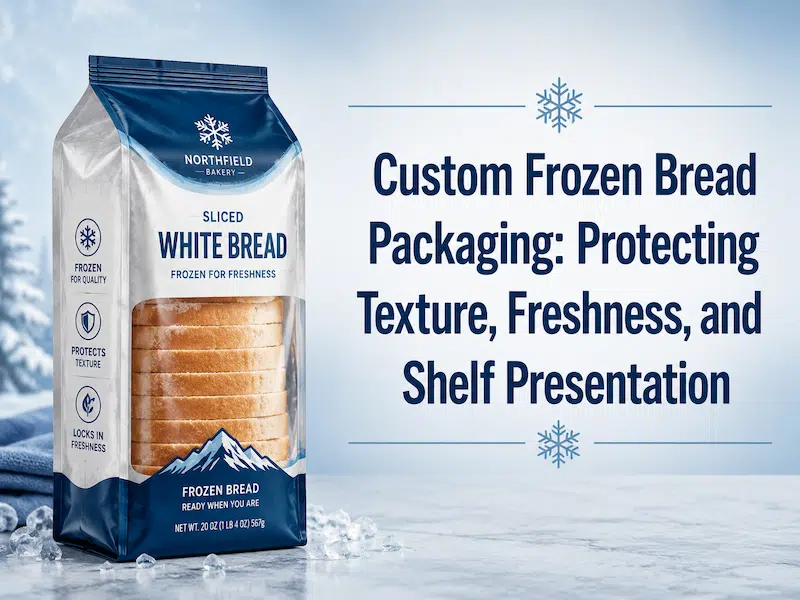
 Frozen sliced bread packaging has to protect more than appearance. It needs to help preserve softness, moisture balance, flavor, aroma, and slice quality through freezing, storage, transport, retail handling, and home freezer use.
For a premium sliced sandwich bread product, the pouch should be developed from the product outward. The structure, material, zipper, window, matte finish, and printing all need to support the same goal: keeping the bread in good condition for the intended frozen shelf life.
This is where custom frozen bread packaging becomes a technical packaging decision, not just a design project.
Start With the Custom Frozen Bread Packaging Problem
Frozen bread is sensitive to moisture movement. If the pouch does not manage moisture vapor properly, the bread can dry out, lose softness, or develop poor texture during storage. Oxygen exposure can also affect flavor and aroma over time.
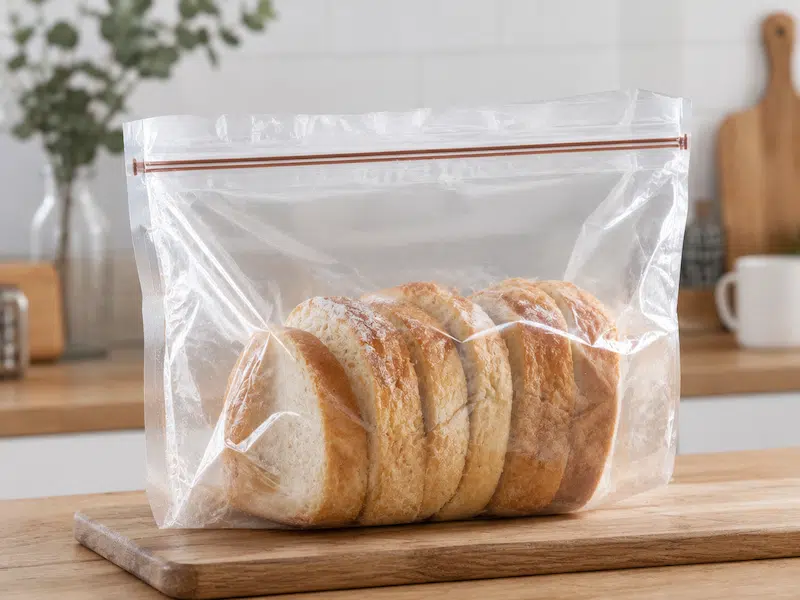
The package also needs to survive real cold-chain handling. Films can feel stiffer after freezing. Seals can be stressed during stacking and shipping. A zipper that works well at room temperature still needs to be tested after freezing.
For frozen bread pouch packaging, the key questions are simple:
- Will the pouch help control moisture loss?
- Can the seals hold through freezing and handling?
- Does the material support the 12-month frozen shelf life target?
- Will the zipper still reclose after freezer storage?
- Does the window affect barrier performance?
These questions should come before artwork.
Why a Flat-Bottom Pouch Fits Premium Frozen Bread
A custom flat bottom pouch, also called an 8-side seal pouch, can work well for premium frozen sliced bread because it gives the package structure.
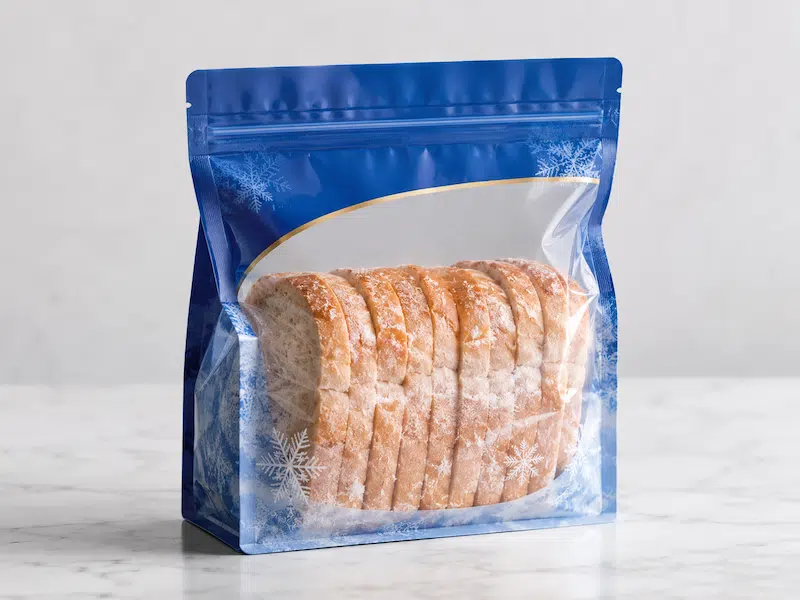
For an approximate size of 11″ W x 6″ D x 14″ H, the pouch needs to hold a bulky product without looking loose or collapsed. The flat bottom helps the pack stand upright. The front, back, and side panels create a cleaner retail shape and more space for branding, nutrition information, preparation instructions, and freezer-case communication.
This format is especially useful when the product needs a stronger retail presentation than a standard loose frozen bag.
The filled pouch should still be tested with real bread. Slice count, loaf height, headspace, compression, and carton packing can all change the final appearance.
Zipper, Window, and Matte Finish Should Support Performance
A resealable zipper is useful for multi-use frozen bread packs. Customers may remove a few slices and return the pouch to the freezer, so the zipper should be easy to use and reliable after cold storage.
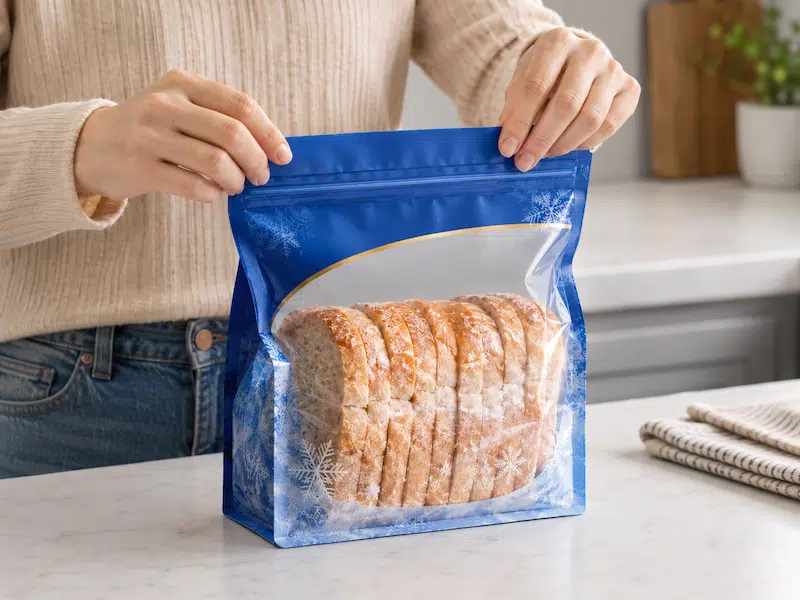
Zipper placement, top seal area, opening width, and repeated open-close performance should be reviewed during sampling. Frozen-condition testing is important because cold temperatures can affect film stiffness and zipper feel.
A front viewing window can help customers trust the product. It shows slice quality, crust color, and texture before purchase. But the window is not only a design choice. It changes the material structure and may affect moisture or oxygen protection.
A matte finish can give the pouch a more premium look, but it should also be compatible with the printing method, film structure, freezer handling, and scuff resistance expectations.
Material Structure Should Follow the Shelf-Life Target
There is no single material structure for every frozen bakery package.
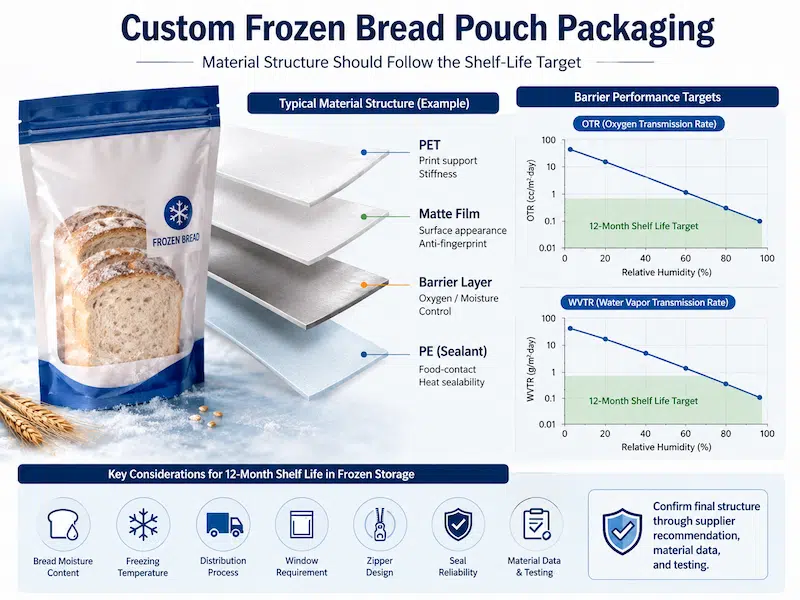
The final structure should depend on bread moisture content, filling method, freezing temperature, distribution process, window requirement, zipper design, and the 12-month shelf life target.
A practical structure discussion may include PET for print support and stiffness, matte film for surface appearance, barrier layers for oxygen or moisture control, and a food-contact inner layer such as PE or another suitable sealant film. The exact structure should be confirmed through supplier recommendation, material data, and testing.
Food-contact suitability still matters, but for this type of frozen bakery pouch, the more useful technical conversation often centers on barrier performance, seal reliability, and how the material behaves in frozen storage.
OTR and WVTR in Plain Business Language
OTR means oxygen transmission rate. It relates to how much oxygen can pass through the packaging material over time. Oxygen can affect flavor, aroma, and product quality.
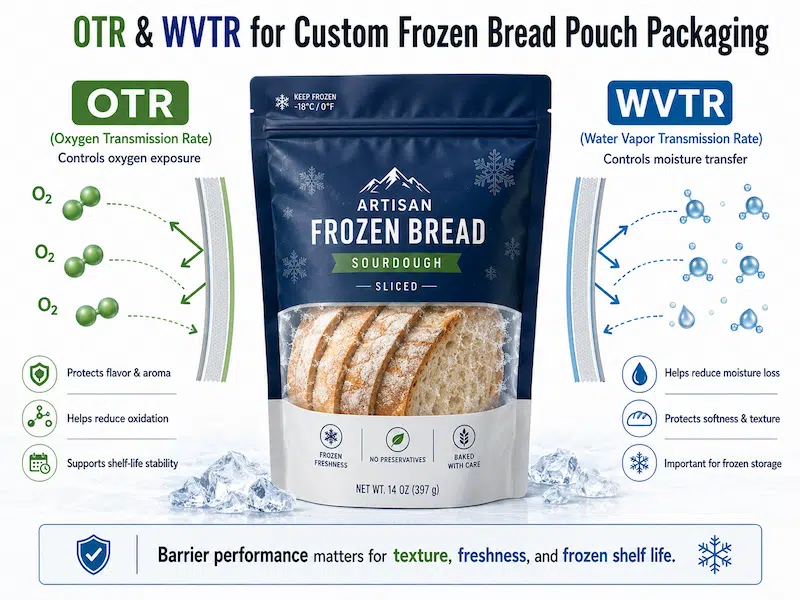 OTR means oxygen transmission rate. It relates to how much oxygen can pass through the packaging material over time. Oxygen can affect flavor, aroma, and product quality.
Do not rely on guessed values. If the shelf-life target is 12 months, ask for material data, test methods, and shelf-life validation where possible. ASTM publishes recognized test methods for packaging films, including ASTM D3985 for oxygen gas transmission rate and ASTM F1249 for water vapor transmission rate. These standards are useful references when discussing OTR, WVTR, and material data with suppliers.
What to Ask Before Production
Serious frozen bakery packaging should be checked through sampling, testing, and documentation.
Ask suppliers about FDA food-contact compliance, migration testing where applicable, material data sheets, declarations of compliance, ISO certification if available, BRCGS Packaging certification if available, traceability, and quality control records. BRCGS describes its Packaging Materials standard as a recognized benchmark for packaging manufacturers, but certification should always be confirmed with current documents. BRCGS Packaging Materials
Prototype samples should be tested with real bread, real fill quantity, and expected freezing conditions. Useful checks include seal testing, zipper testing, drop and handling tests, carton packing review, freezer storage review, and filled pouch appearance review.
If the product line includes several SKUs, MOQ splitting may be possible when dimensions, structure, and printing method are the same. It still depends on production setup, artwork count, total quantity, and printing process.
Final Direction
Custom frozen bread packaging should protect texture and freshness first, then support retail presentation. A flat-bottom / 8-side seal pouch can be a strong format for premium frozen sliced bread, but the final pouch should be proven through material review, prototype sampling, and frozen-condition testing.
GCLPacking can support frozen bakery brands with material selection, dieline review, prototype samples, printing, pouch production, and production-ready recommendations for custom flat-bottom frozen food pouches.