
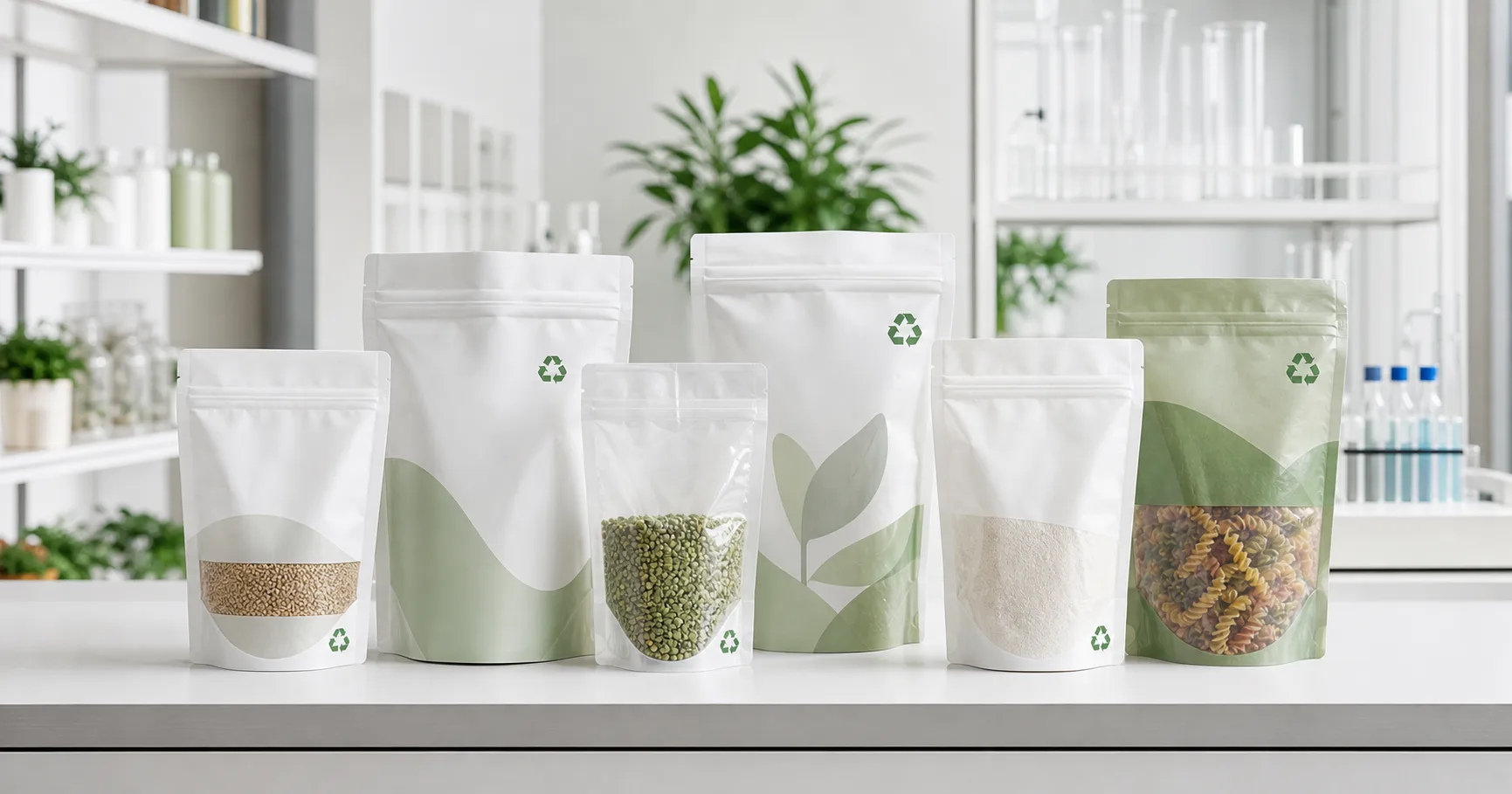
Are stand up pouches recyclable? The short answer is: some are, but many conventional stand up pouches are not recyclable through standard curbside recycling programs. If you are still comparing formats, this stand up pouch packaging guide explains the basic structure, uses, and buying decisions behind the format.
Recyclability depends on the pouch material, barrier layers, adhesives, inks, zipper, spout, food residue, and whether local recycling systems actually accept flexible plastic packaging. A pouch can look simple from the outside while being made from several bonded layers inside. That structure often protects the product very well, but it can make the package difficult to recycle after use.
For brands, the important question is not only whether a pouch is technically recyclable. The better question is whether the pouch can be collected, sorted, processed, and reused through a real recycling pathway that customers can understand.
Quick Answer
| Question | Practical Answer |
|---|---|
| Are all stand up pouches recyclable? | No. Many are multilayer structures that are not accepted in standard recycling. |
| Can they go in curbside recycling? | Usually no, unless local rules specifically accept that exact pouch type. |
| Which pouch types have better recycling potential? | Mono-material PE or PP pouches with compatible closures and no foil layer. |
| Are foil-lined pouches recyclable? | Usually not through standard consumer recycling systems. |
| What should brands ask suppliers? | Material structure, recycling stream, compatible closures, barrier content, and claim support. |
Why Stand Up Pouches Are Hard to Recycle
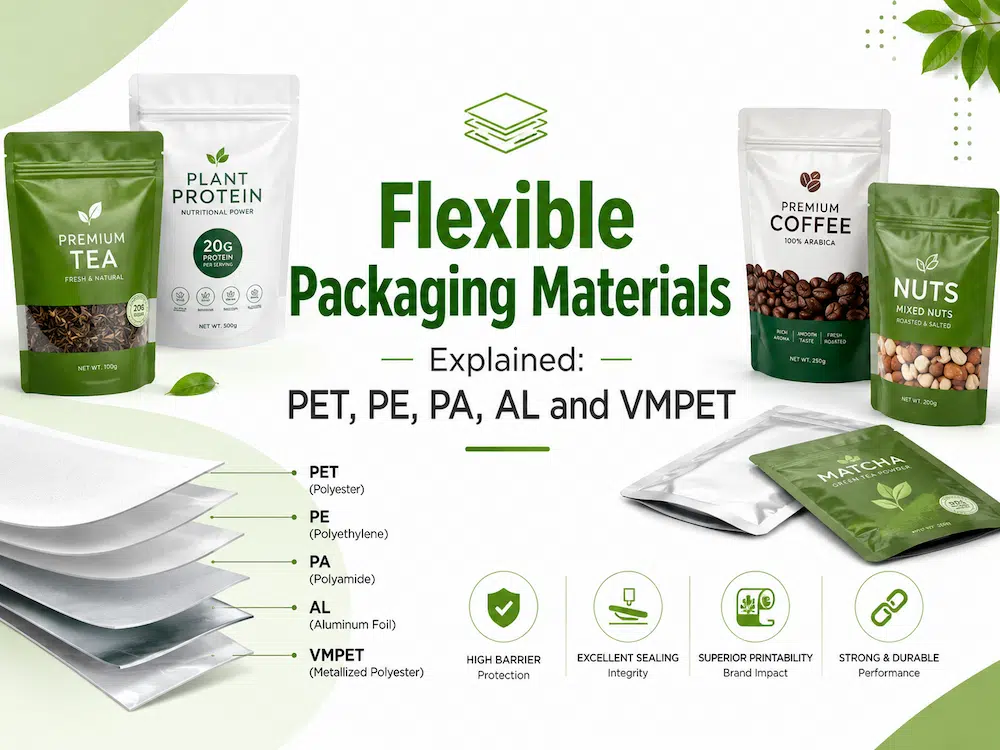
Stand up pouches are hard to recycle because many are made from multilayer films. A single pouch may combine PET, PE, nylon, aluminum foil, EVOH, paper, adhesives, inks, coatings, and a separate zipper or spout. For printed retail packaging, the material structure should be reviewed together with artwork, finish, and sealing needs; this custom printed stand up pouches guide covers those planning decisions in more detail.
Each layer has a job. PET can add stiffness and print quality. PE can provide sealability. Aluminum foil can block oxygen, light, and aroma transfer. Nylon can improve puncture resistance. EVOH can improve oxygen barrier performance.
The problem is that mechanical recycling works best when the material stream is clean and consistent. A mixed-material pouch is difficult to separate into usable resin streams, so many recycling systems treat it as residue.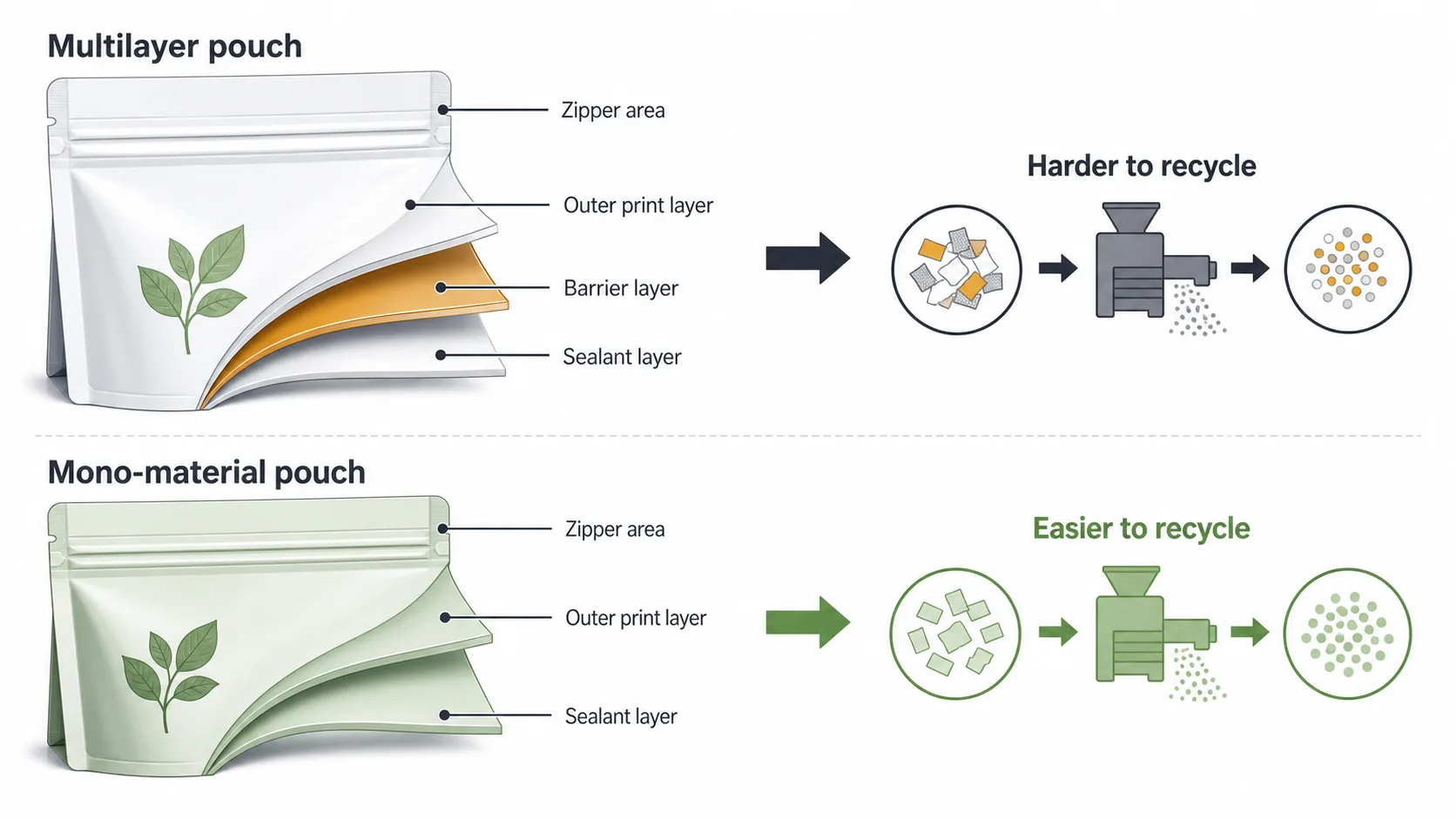
Common pouch components affect recyclability in different ways. PET can improve print quality and stiffness, but it may conflict with PE film recycling. PE is often useful because it can provide sealability and may fit PE-based recycling streams when the whole structure is compatible. Aluminum foil is excellent for barrier protection, but it usually makes standard recycling much harder.
Smaller details matter too. Zippers, spouts, caps, adhesives, coatings, and inks should be reviewed as part of the full package, not as separate afterthoughts. A recyclable pouch body can still become difficult to process if the closure or barrier system is incompatible.
Curbside Recycling vs. Store Drop-Off
Most stand up pouches should not be placed in curbside recycling unless the local recycling program clearly accepts them. Flexible films can wrap around sorting equipment, fall through screens, or contaminate rigid plastic streams. The U.S. EPA’s guidance on how to recycle common recyclables is a useful reminder that local rules matter.
Some clean polyethylene films may be accepted through store drop-off programs, depending on the region and the exact package. However, not every pouch qualifies. Heavy printing, foil layers, food residue, rigid spouts, mixed materials, and incompatible barriers can all disqualify a pouch.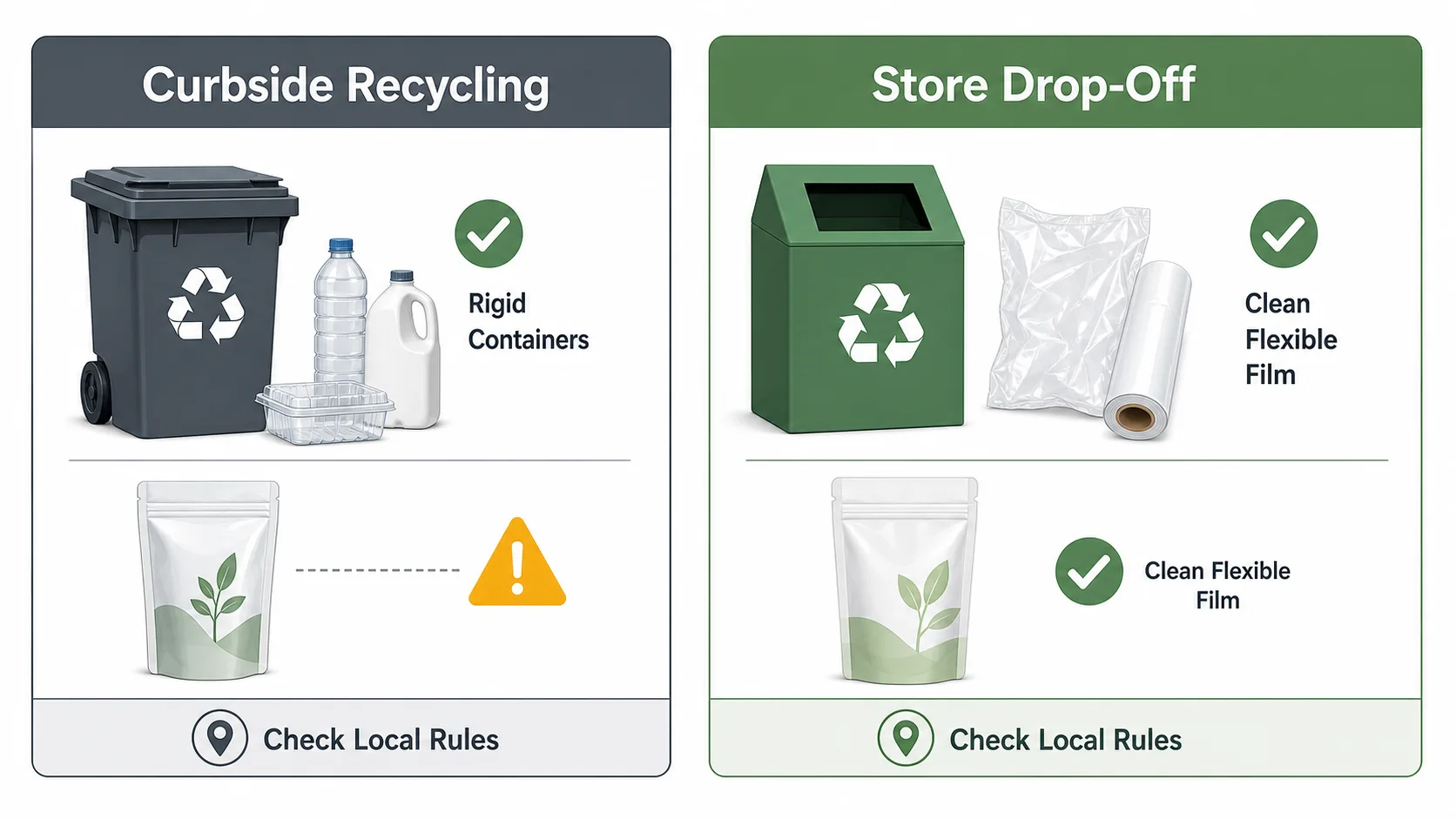
Curbside recycling is usually built around rigid containers, paper, cardboard, glass, and metal. Store drop-off programs are more relevant for certain clean flexible PE films, but they are not a universal answer for every pouch. Specialty recycling may exist for some hard-to-recycle formats, but it is less convenient and should not be treated as mainstream access.
If a pouch has no clear recycling label, has foil lining, contains product residue, or includes rigid mixed-material parts, the safer consumer instruction is usually to keep it out of curbside recycling. In the U.S., the FTC’s Green Guides also caution that recyclable claims should be qualified when recycling facilities are not available to a substantial majority of consumers; see 16 CFR 260.12 on recyclable claims.
When Can Stand Up Pouches Be Recyclable?
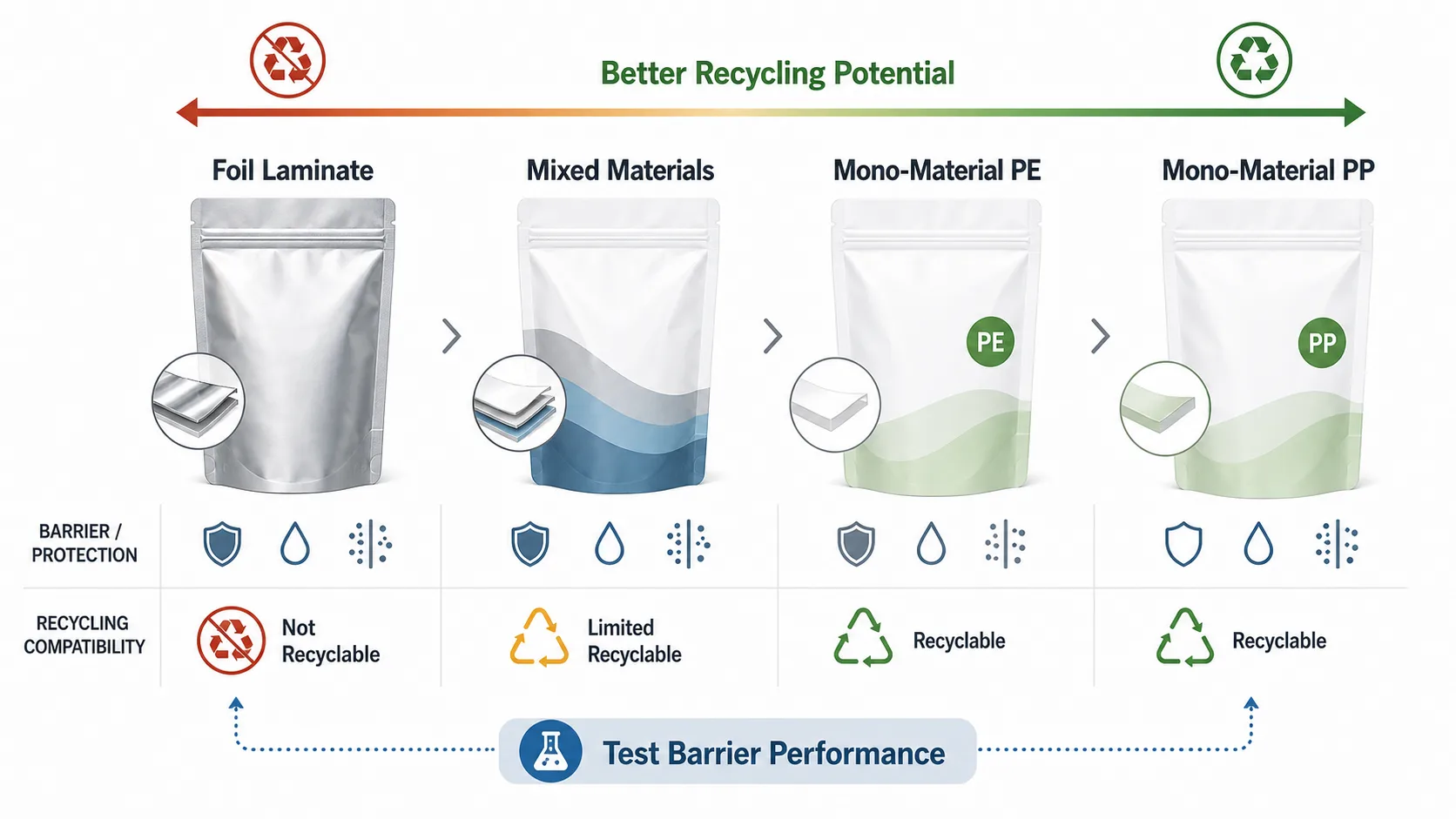
Stand up pouches are more likely to be recyclable when they are designed as mono-material structures. In practice, this often means a pouch made mainly from polyethylene or polypropylene, with compatible closures and minimal incompatible barrier materials.
A more recycling-friendly pouch usually has:
- A PE-based or PP-based mono-material structure
- No aluminum foil layer
- No paper-plastic-foil laminate combination
- Compatible zipper, valve, spout, or cap
- Minimal incompatible barrier coatings
- Clean and dry post-use condition
- Clear disposal instructions
- Verified recycling claim support
That still does not mean every mono-material pouch is curbside recyclable. It means the pouch is more likely to fit an existing or emerging flexible packaging recycling pathway.
Material Structure Comparison
| Pouch Structure | Common Use Case | Recyclability Outlook | Notes for Brands |
|---|---|---|---|
| PET / foil / PE | Coffee, powders, high-barrier foods | Poor | Strong protection, weak recyclability |
| PET / nylon / PE | Snacks, pet treats, durable pouches | Limited | Good strength, mixed-polymer challenge |
| Paper / foil / plastic | Natural-looking high-barrier packs | Poor | Paper look can hide complex layers |
| Mono-material PE | Dry goods, some snacks, powders | Better | Check drop-off or regional acceptance |
| Mono-material PP | Snacks, dry foods, some refill packs | Better but region-dependent | Collection access varies |
| Certified compostable film | Food-contaminated or compost-linked products | Depends on composting access | Must match real composting infrastructure |
Are Foil-Lined Stand Up Pouches Recyclable?
Most foil-lined stand up pouches are not recyclable through standard consumer recycling systems.
Foil layers are common in coffee packaging, protein powders, dehydrated foods, premium snacks, and products that need strong oxygen, aroma, or light protection. The foil improves shelf life, but it also creates a mixed-material laminate that is difficult to separate.
Brands should not remove foil without testing shelf life. A recyclable structure that fails to protect the product can create product waste, returns, and customer complaints. The right approach is to test whether newer mono-material high-barrier films can meet the product’s protection requirements.
How to Tell If a Stand Up Pouch Is Recyclable
Consumers and brands can use the following checklist before making or trusting a recycling claim.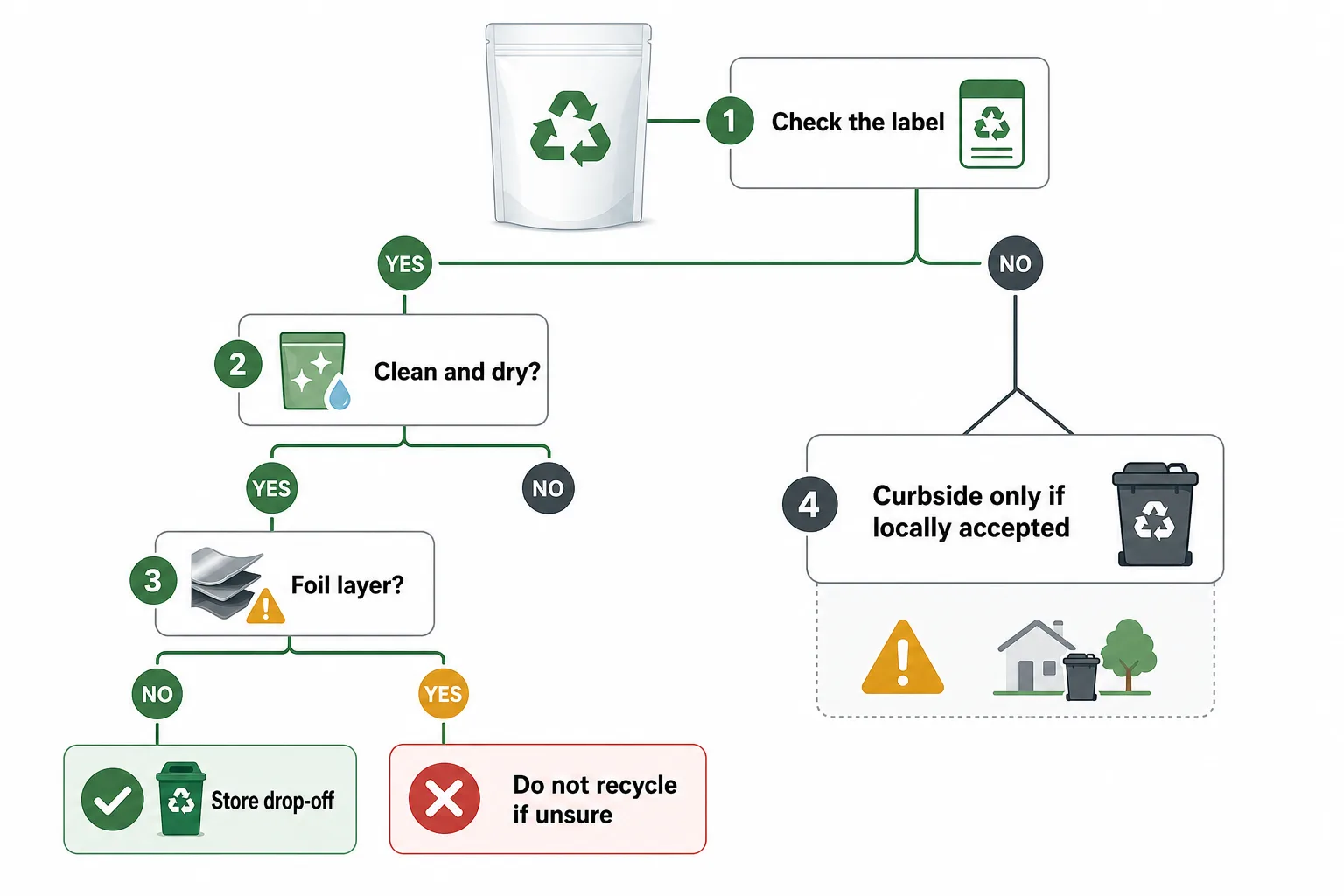
| Checkpoint | Better Sign | Warning Sign |
|---|---|---|
| Material family | Mostly PE or mostly PP | PET/foil/PE, paper/foil/plastic, mixed laminate |
| Barrier system | Compatible coating or low-level barrier | Aluminum foil or heavy incompatible barrier |
| Closure | Same or compatible polymer | Mixed-material zipper, spout, cap, or valve |
| Label instructions | Specific store drop-off or local guidance | Generic recycle symbol with no instructions |
| Use condition | Clean and dry after use | Greasy, wet, sticky, or food-contaminated |
| Recycling access | Accepted by a real program | No collection route available |
| Claim support | Supplier documentation and design review | Vague terms like eco-friendly or green |
Brand Decision Matrix
For packaging buyers, recyclability should be evaluated alongside product protection, filling method, retail requirements, and customer disposal behavior.
If maximum shelf life is the priority, a high-barrier multilayer pouch may still be necessary. If recyclability is the priority, start with mono-material PE or PP and then verify whether it can meet the product’s shelf-life and filling requirements.
For natural-looking packaging, do not assume a kraft or paper-like exterior means the pouch is recyclable. Many kraft-style pouches still use plastic, foil, or laminated barrier layers inside. If you are considering a paper-look structure, compare the sustainability claim against the actual material layers in this custom kraft stand up pouches guide. For refill packaging, review spouts, caps, and fitments early because they can change the recyclability story of the whole package.
Supplier Questions Before Ordering Recyclable Stand Up Pouches
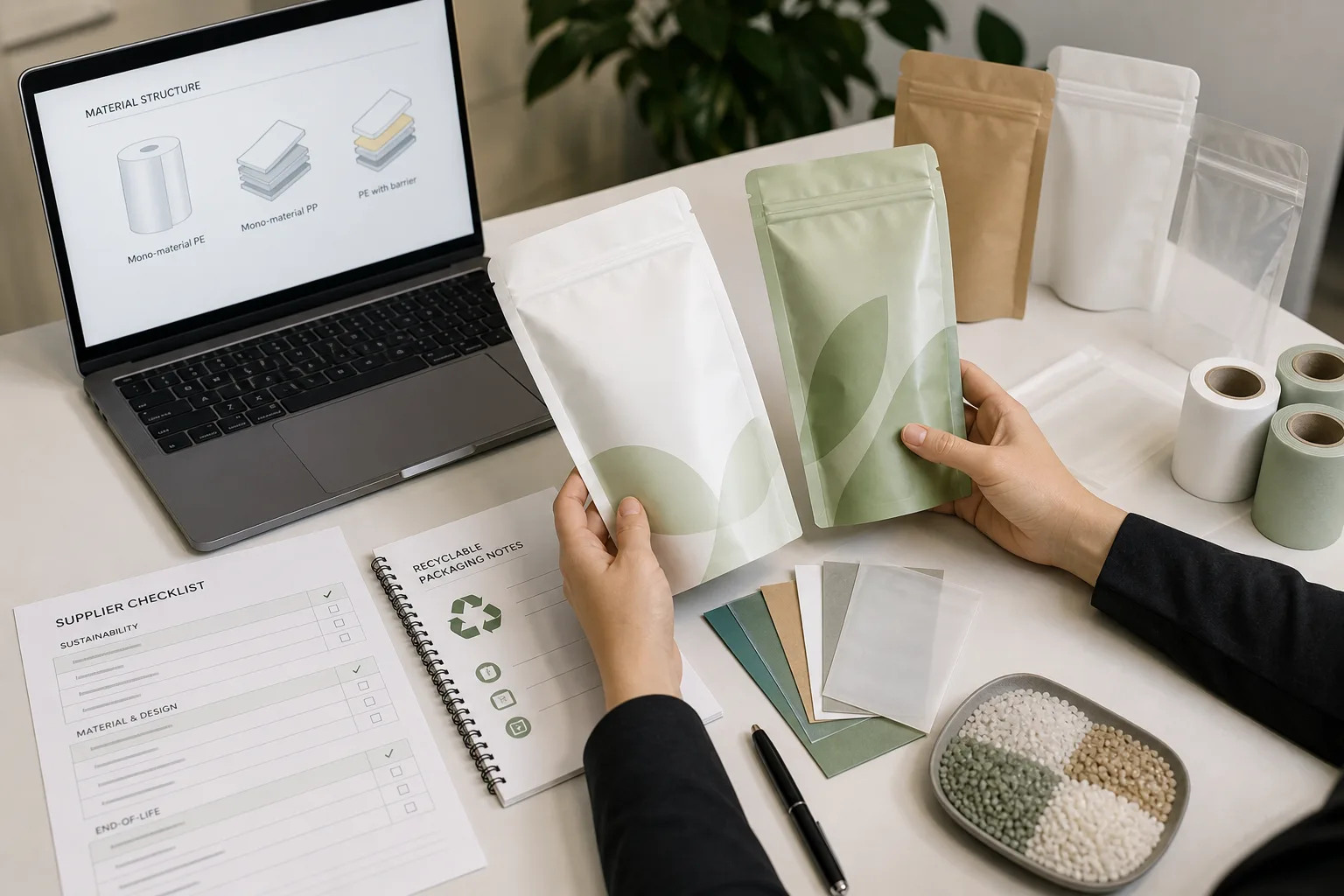
Before approving a recyclable pouch, ask the supplier for specific answers rather than broad sustainability language. Packaging size, filling method, and sealing area can also affect whether the final package performs well, so pair recyclability questions with practical checks from this custom stand up pouch sizes guide and this guide on how to fill stand up pouches.
| Question to Ask | Why It Matters |
|---|---|
| What is the full material structure? | Recyclability depends on every layer, not just the outer film. |
| Is the pouch PE-based, PP-based, or mixed-material? | Recycling streams are usually polymer-specific. |
| Does the pouch contain aluminum foil? | Foil usually makes standard recycling much harder. |
| Are the zipper and valve compatible? | Small components can affect the whole package claim. |
| Which recycling pathway is the claim based on? | Curbside, store drop-off, and specialty programs are different. |
| In which markets is the claim valid? | Recycling access varies by country, state, and city. |
| What disposal wording should appear on pack? | Clear instructions reduce consumer confusion. |
| Has the structure been tested for shelf life? | Recyclability should not compromise product protection. |
Example Disposal Wording
Clear disposal wording helps customers avoid wishcycling. The exact wording should be reviewed against the market, material, and claim support, but these examples show the level of specificity brands should aim for.
For a mono-material PE pouch accepted through drop-off, wording such as “Store drop-off where accepted. Empty, clean, and dry before recycling” is clearer than a generic recycling symbol. For a pouch with uncertain local access, “Check local recycling rules before disposal” is safer. For a foil-lined multilayer pouch, avoid vague recycling claims and state that it is not recyclable through standard curbside programs when that is the accurate instruction.
If a pouch is compostable, the label should specify the correct composting environment. “Compostable” is not enough by itself if customers do not have access to a facility that accepts that material. For broader context, the EPA tracks containers and packaging as a major part of municipal solid waste in its containers and packaging data.
Recyclable Pouches vs. Compostable Pouches
Compostable stand up pouches are not automatically better than recyclable pouches. A compostable pouch only works when it is certified for the correct composting environment and actually reaches that environment.
If a compostable pouch goes to landfill, it may not deliver the intended benefit. If it enters plastic recycling, it can contaminate recyclable material. For many dry goods, a recyclable mono-material pouch may be more practical. For food-contaminated packaging in markets with commercial composting access, compostable packaging may deserve consideration.
The key is infrastructure. A recyclable pouch needs a realistic flexible packaging collection and processing route. A compostable pouch needs the right certification and access to a composting system that accepts it. Without that end-of-life pathway, either claim can become confusing for customers.
Conclusion
Are stand up pouches recyclable? Some are, but many conventional stand up pouches are not recyclable through standard curbside recycling. The most promising options are usually mono-material PE or PP pouches designed with compatible closures, limited barrier complexity, clean disposal conditions, and clear recycling instructions.
For consumers, the safest rule is to follow the label and local recycling guidance. For brands, the better path is to design the pouch around real-world recyclability: collection, sorting, processing, and end-market demand. A recyclable stand up pouch should protect the product first, then fit a disposal pathway customers can actually use.
FAQ
Are stand up pouches recyclable?
Some stand up pouches are recyclable, but many are not accepted in standard curbside recycling. Recyclability depends on material structure, barrier layers, closures, contamination, and whether local recycling systems accept flexible packaging.
Can stand up pouches go in curbside recycling?
Most stand up pouches should not go in curbside recycling unless local rules specifically accept them. Flexible packaging can interfere with sorting equipment and may contaminate rigid plastic recycling streams.
What makes a stand up pouch recyclable?
A recyclable stand up pouch is usually made from a compatible mono-material structure, such as PE or PP, with no foil layer, compatible closures, clear disposal instructions, and access to a real recycling program.
Are foil-lined stand up pouches recyclable?
Most foil-lined stand up pouches are not recyclable through standard consumer recycling systems. Foil provides strong barrier performance, but it creates a multilayer structure that is difficult to separate and process.
Are compostable pouches better than recyclable pouches?
Compostable pouches are only better when they are certified and collected by the right composting system. For many dry products, recyclable mono-material pouches may be more practical than compostable alternatives.